
 Posts
Posts


Tuesday, September 29, 2009
A Dog-dancing Day in the Park
It's always a treat when I see these dogs converging from different directions. It means there's going to be an impromptu performance.


The Home-Loan Ranger
The secret is apparently out that Bank of America is not happy with me lately. They bought out the crooks at Countrywide and now manage the outrageous, obscene, inflated, slippery mortgage I ended up with two years ago.
They somehow think that I'm going to let go of the little, one-bedroom house I moved into more than 22 years ago. It'll never happen. Where would I put the mountains of stuff I've pack-ratted for decades? They don't make a shopping cart big enough.
Besides, I gave up camping out and sleeping under the stars when I got out of the Army. To me, "roughing it" is a room at Motel 6 next to the loud ice machine.
I knew that my footrace with foreclosure was public knowledge when at least three people told me about some big shindig at the Los Angeles Convention Center this weekend -- an event where folks like me could go and maybe find some creative way to distract the vultures.
The last thing I figured I'd encounter there today was a conversation with a true urban hero -- I call him The Home-Loan Ranger.
His name is Bruce Marks and he's the founder and CEO of the Neighborhood Assistance Corporation of America (NACA). Neighborhood assistance is an understatement. What he runs is more like a guerrilla army.
When I heard him tell the crowd of a couple thousand of my delinquent brethren about how he "gets the attention" of the CEOs of banks and other lending institutions, I darn near wanted to build a stature of him on Figueroa Street or something.
He's doing the stuff I dream of doing. When the rich, fat-cat executives ignore his calls for restructuring the rancid loans his troops are stuck with, he leads a small batallion of them to the CEO's doorstep -- the home doorstep.
He gives out their home phone numbers and encourages everyone and their relatives to call the big wheel at home -- every 15 minutes.
I don't know where I've been that I haven't heard about his delightful tactics or about the other massive gatherings he's been hosting. I had to learn more -- from the horse's mouth.
I waited for him to finish an inspirational pep rally and I approached him with notebook in hand.
It's great to be a journalist. Such access. Such respect (sort of).
Within 20 minutes or so we had found a less-noisy spot and I picked his brain apart.
Then I talked to a few of the thousands of people he had helped this weekend and I began to feel just how much of a Pied Piper the Loan Arranger really is.
Here's a short sample of what he and a couple of others told me:
I'll be heading off in the next couple of weeks to one of his next gatherings in either Phoenix, Las Vegas or Oakland. It turns out I didn't have all of the paperwork that they require. Plus, a couple of weeks gives me some more time to nail down some additional work assignments.
I want to grow up to be like Bruce Marks.
Maybe he needs a sidekick. The Loan Arranger and Donto!
They somehow think that I'm going to let go of the little, one-bedroom house I moved into more than 22 years ago. It'll never happen. Where would I put the mountains of stuff I've pack-ratted for decades? They don't make a shopping cart big enough.
Besides, I gave up camping out and sleeping under the stars when I got out of the Army. To me, "roughing it" is a room at Motel 6 next to the loud ice machine.
I knew that my footrace with foreclosure was public knowledge when at least three people told me about some big shindig at the Los Angeles Convention Center this weekend -- an event where folks like me could go and maybe find some creative way to distract the vultures.
The last thing I figured I'd encounter there today was a conversation with a true urban hero -- I call him The Home-Loan Ranger.
His name is Bruce Marks and he's the founder and CEO of the Neighborhood Assistance Corporation of America (NACA). Neighborhood assistance is an understatement. What he runs is more like a guerrilla army.
When I heard him tell the crowd of a couple thousand of my delinquent brethren about how he "gets the attention" of the CEOs of banks and other lending institutions, I darn near wanted to build a stature of him on Figueroa Street or something.
He's doing the stuff I dream of doing. When the rich, fat-cat executives ignore his calls for restructuring the rancid loans his troops are stuck with, he leads a small batallion of them to the CEO's doorstep -- the home doorstep.
He gives out their home phone numbers and encourages everyone and their relatives to call the big wheel at home -- every 15 minutes.
I don't know where I've been that I haven't heard about his delightful tactics or about the other massive gatherings he's been hosting. I had to learn more -- from the horse's mouth.
I waited for him to finish an inspirational pep rally and I approached him with notebook in hand.
It's great to be a journalist. Such access. Such respect (sort of).
Within 20 minutes or so we had found a less-noisy spot and I picked his brain apart.
Then I talked to a few of the thousands of people he had helped this weekend and I began to feel just how much of a Pied Piper the Loan Arranger really is.
Here's a short sample of what he and a couple of others told me:
I'll be heading off in the next couple of weeks to one of his next gatherings in either Phoenix, Las Vegas or Oakland. It turns out I didn't have all of the paperwork that they require. Plus, a couple of weeks gives me some more time to nail down some additional work assignments.
I want to grow up to be like Bruce Marks.
Maybe he needs a sidekick. The Loan Arranger and Donto!
Friday, September 25, 2009
Leti lights up the morning

Her name is Leticia, but anyone with that name in Mexico quickly becomes Leti.
She's one of the many people who make the rounds at the local park. Her eyes are so warm that they light up the morning. She's not the only visitor in search of recyclables. You'd be amazed at the number of hard-working and dedicated residents who count on bottles and cans to round out whatever income they need to keep kids dressed and in school and to pay the rent an utilities.
Leti has been in the Burbank area for ten years. You might have seen her with long, beautiful hair that cascaded down to her waist. But she had a stroke that apparently triggered a heart attack.
"They had to cut my hair," she said in Spanish, "so they could cut into my head.
"Touch here," she said in English as she parted her hair. I was willing to believe her, but she seemed insistent on having me feel the lump.
People who don't speak Spanish believe that I'm fluent in it. Those who know Spanish instantly know that I'm just a beginner who speaks more quickly than other beginners. The same applies to my piano playing, by the way. I can't fool real musicians.
I tell you this to apologize for any information that I may have gotten wrong this morning when Leti stopped by to meet Mija (my dog -- you can check out the video down further in the blog). What I never knew what how fast Leti speaks in Spanish as well as in the limited English she's learning. She's taking classes at the local adult center and apparently doing very well.
But back to her stroke/heart attack. From what I could pick up, she was pregnant at the time and that complicated things even more. I believe she was paralyzed for a while and couldn't speak.

That's certainly not the case now. She gets up early every morning and walks a little more than a mile to the park. I'm certain she has other stops along the way. Two days a week she cleans houses for two clients.
She spent a couple of minutes describing in English -- backed up in rapid Spanish -- the excellent work she does cleaning houses. I could tell it was a matter of great pride for her.
She told me that she'll clean a complete house for $50, but she hinted that she works a lot harder in the afternoon is the client shares lunch with her. Apparently, one of the clients in the past didn't believe that she should stop to eat.
What fun is it having a friendly, qualified and speedy housekeeper if you can't share lunch with her or him. Besides, that how I brush up on my Spanish.
Leti doesn't have a phone where she lives in Burbank, but her sister, Marisol does. If you should want to meet Leti and experience her high energy and higher enthusiasm, e-mail me at donray@donray.com or call me directly.
I'll hook you up.
She'll light up your morning also!

Thursday, September 24, 2009
The girl I never met

I accepted an invitation to join some fellow Vietnam veterans who get together once a week to share poems that they've written about their post-traumatic stress disorder (PTSD).
It turns out that it's therapeutic to express inner fears and feelings and share them.
When I returned from Vietnam, I also wrote a few poems. The interesting thing is that I didn't know that I was doing the same thing these vets are doing today -- I was expressing inner fears and feelings.
PTSD works in strange ways, it turns out.
Because my job in Vietnam was to work alone at night with only my dog, I didn't develop many of those close friendships with fellow soldiers that my colleagues who fought in other wars may have developed.
My best friends were the two dogs I worked mostly with: Fritz and Ralph (the cute little fellow in the photo).
When I got out of the Army, I went straight in to Los Angeles Pierce Community College with the belief that I'd end up a veterinarian (I'll tell you the amazing story about how that dream came about, but in a later posting). One of the first classes I took was astronomy. If you go back into the earlier blogs, you'll read about the constellation Southern Cross. It's connected to that.
It was in my astronomy class that an attactive and friendly looking young woman attracted my attention. What I didn't know back then, was that the early signs of my PTSD were showing up.
After weeks of wishing that I could be her friend, but being unable to make it happen, I wrote the poem.
I never gave it to her.
In preparation for meeting with the veterans' poetry group, I found the old poem. When I read it, I immediately understood what was at work in my mind.
The Girl I Never Met
By Don Ray
You might be Sue or Cindy —
Monique, Marie, Michele.
You could be Cathy, Kay or Chris
As far as I can tell.
Your name is, quite regrettably,
Unknown to me as yet.
Unless we’re introduced, you’ll be
The girl I never met.
That day when I first saw you,
A month or so ago,
I vainly tried to smile at you
And simply say, “Hello.”
We see each other frequently —
A dozen times a week.
I can’t help feeling close to you
Although we never speak.
I wonder if you wonder
What I’m thinking when I stare.
If you think I think I’m good for you,
You haven’t got a prayer.
I guess I should explain it now —
My silence from the start —
Thought I appear unsociable,
I’m cowardly at heart.
So be happy that we’re strangers.
It’s really not profound.
As long as I don’t know you
I can never let you down.
You’ll always be a friend to me
But, one day, I’ll regret
I never really got to know
The girl I never met.
Saturday, September 19, 2009
McFlashbacks with a side of Pride
Just about every morning, I take my spectacular dog, Mija, to the local park.
It's not for enjoyment -- it's her job. Every morning she heads for the ivy that surrounds the tennis courts and searches for a tennis ball. When she finds a ball -- and she always does, the work is over and the fun begins. She has trained me to throw it and then, when she retrieves it, to throw it again.
And again and again.
But that's a story for another time. This story begins at the same park, but in the dark hours before midnight. I was blessed to have my stellarly stunning wife, Xiao Mei, accompany Mija and me to the park. Mija enjoys showing off for Xiao Mei. Xiao Mei enjoys pretending to not be impressed. I prete nd to not notice.
As we entered the park, I noticed the couple sleeping on the grass behind the trunk of a big tree. One of them was wearing a white sweatshirt with the hood pulled up over the head. A couple of days earlier, I had seen a big fellow sitting with his wife or girlfriend on the bleachers watching an imaginary softball game.
He had been wearing the hood of a white sweatshirt over his head. The sweatshirt draped down his back and, from afar, looked like long, white hair. My park friend, Larry, told me later that they were, like him, homeless and that the guy had beaten him to a pulp a while back.
I didn't tell Xiao Mei who I thought the sleeping couple was -- I simply steered us in a different direction on the walk back home.
The following morning, Mija and I were there doing our respective jobs. It was shortly before 8 a.m. when she and I started walking across the baseball fields in the direction of home. That's when we noticed a young couple with their three-year-old (probably) daughter walking away from the spot where the people had been sleeping the night before.
It was the woman, it turns out, who was wearing the white sweatshirt with the hood keeping her ears warm. And the guy was much smaller and thinner than the homeless man who had messed with Larry.
They were carrying some blankets, some makeshift bags and the little girl's Teddy bear and they were walking in the direction of the public restrooms on the opposite side of the ball fields. Park workers open the restrooms at about 8 a.m.
I kept walking toward home, but I couldn't stop thinking about the young couple and that little girl having slept all night in the park. Something made me turn around and walk in the direction they were walking.
I finally caught up with them when they reached the restrooms -- which were still locked. The mother stood off to one side with the little girl while the father checked the doors.
"You were in the park last night," I said to the man. He had warm, friendly eyes. He looked to be in his early-to-mid 20s. He hadn't shaved in a couple of days, but he didn't have any of the telltale signs of being a careen homeless person.
I know now that I should have approached him with a better first line.
"No," he said with a friendly smile, "we weren't in the park last night."
"I'm going to be at the McDonald's down the street in about 15 minutes," I said. "Could I buy you folks some breakfast?"
"We weren't in the park last night," he said again, a bit more firmly. "We like to come here in the morning."
I knew better. I'd never seen them before. "I must have been mistaken," I said in a desperate attempt to undo the damage I figured I'd already done. "The couple I saw last night were wearing the same colored clothes. You must be embarrassed that I made such a stupid mistake. I certainly am."
The whole time, his wife or girlfriend stood about 20 feet away with her daughter and just listened. I strategically bid him a farewell, offered up another apology and headed home.
I wasn't even halfway there when it became perfectly clear to me that I couldn't continue my day without doing something.
That's when I had the McFlashback.
When I was about three years old, we lived in a little, one-bedroom house at 11116 Weddington Street in North Hollywood.
My sister and I shared a sofa that flattened out into a bed. The living room was the dining room and vice versa. My mother backed a couple of dining room chairs up against the sofa to keep me from falling out. When my father wasn't looking, she would pin a bathroom towel around as a makeshift diaper. If Dad found out I had wet the sofa, there would be a bad scene.
The man with the baseball cap and the flashlight came to the door in the middle of the night. It's the first memory I have of being alive. It was a disturbance. Our parents were clearly afraid and were scrambling to get whatever it was that the man in the baseball cap wanted. They didn't turn on any lights -- probably so they wouldn't wake my sister and me.
It would be years later that I would figure out what had happened that night -- what that man wanted. He was either a bookie, a loan shark or one of my father's co-workers at Lockheed Aircraft who my father had scammed. You see, my father was a horse race addict and, by that time, had already pretty much ruined their marriage. This man wanted his money and wasn't going to leave peacefully until he got it.
McFastforward.
As I walked back home from the park, I couldn't stop thinking about that nightmare and about the three-year-old girl who had slept with her parents on the wet grass the night before. I wondered if, many years later, that little girl would remember hearing her father lie about sleeping in the park and then turn down the offer for food. Even if she didn't hear or understand the conversation, I'm certain that she could feel the tension and wonder what Mommy and Daddy were worried about.
Of course, there was no doubt in my mind that the young father was not being truthful. I figured it was about that ridiculous pride that keeps us men from admitting that we need help. Later, a friend suggested that the young man was afraid that someone might report him to the authorities and they would take the child away.
I felt even more stupid. But back to that day.
When I left home to begin my day, I drove through the local McDonald's and ordered four breakfast meals. I knew that the man would probably not accept it, but it didn't matter. I suppose it became more about me than about them.
I parked my car in the parking lot and walked to a picnic table about 50 feet from where the mother was sitting on a blanket with the little girl. The father was, no doubt, in the restroom cleaning up. I didn't make eye contact with them. Instead, I methodically set the table for four and sat myself down.
Again, I never looked at her and I don't know if she looked at me, but I'm guessing she did.
I ate my breakfast, gathered the empties and deposited them in the nearby trashcan. Of course, I left the three other meals sitting on the table -- orange juice, McMuffin and hashbrown potatoes. I never looked back
As I drove off, I knew that I would never know what happened to the food. Did Mommy and Daddy have a "should we" discussion? Did they scramble to the table and begin eating? Did the little girl ask them why they couldn't eat the food?
I'll never know. And I'll never know if or how that innocent little girl will see life differently because of the crisis her parents were experiencing.
The whole incident, however, made me think more about how easily some circumstances can change the course of someone's life. I pondered about the impact that the circumstance of my childhood had on my life.
Was it a combination of childhood crises, attention deficit disorder, dyslexia and post-traumatic stress disorder from Vietnam (and childhood?) that set the tone for everything that has happened in my life? For as long as I can remember, I've struggled just to keep up with life. I've been blessed with an inflamed curiosity and a radar-like ability to connect with the most wonderful and amazing people -- and a few who were not that wonderful, but equally amazing.
And I've been cursed with the inability to complete stories and projects so that I could share them with people. I'm buried in a massive collection of astoundingly wonderful stories to tell about people anyone would want to get to know.
But instead of crafting the stories and sharing them with people, I've spent my entire adult life (so far) scrambling to keep the wolves off my heels. If only I had the time. If only I had the money. If only I had a working partner. If only I had the breaks.
I cannot keep saying "If only."
I can no longer wait for someone to give me permission to write something or shoot something or to record something. In my heart, I believe that it's time to tell the stories and hope that people read them. I spend so much time encouraging people to sit down with their parents or grandparents and record oral histories.
"It's like being in a library that's burning down," I keep repeating. "You have to move fast."
I'm also a library and I'm feeling the heat.
I hope you'll enjoy the very personal and amazing stories I'm about to share with the world.
It's not for enjoyment -- it's her job. Every morning she heads for the ivy that surrounds the tennis courts and searches for a tennis ball. When she finds a ball -- and she always does, the work is over and the fun begins. She has trained me to throw it and then, when she retrieves it, to throw it again.
And again and again.
But that's a story for another time. This story begins at the same park, but in the dark hours before midnight. I was blessed to have my stellarly stunning wife, Xiao Mei, accompany Mija and me to the park. Mija enjoys showing off for Xiao Mei. Xiao Mei enjoys pretending to not be impressed. I prete
 nd to not notice.
As we entered the park, I noticed the couple sleeping on the grass behind the trunk of a big tree. One of them was wearing a white sweatshirt with the hood pulled up over the head. A couple of days earlier, I had seen a big fellow sitting with his wife or girlfriend on the bleachers watching an imaginary softball game.
He had been wearing the hood of a white sweatshirt over his head. The sweatshirt draped down his back and, from afar, looked like long, white hair. My park friend, Larry, told me later that they were, like him, homeless and that the guy had beaten him to a pulp a while back.
I didn't tell Xiao Mei who I thought the sleeping couple was -- I simply steered us in a different direction on the walk back home.
The following morning, Mija and I were there doing our respective jobs. It was shortly before 8 a.m. when she and I started walking across the baseball fields in the direction of home. That's when we noticed a young couple with their three-year-old (probably) daughter walking away from the spot where the people had been sleeping the night before.
It was the woman, it turns out, who was wearing the white sweatshirt with the hood keeping her ears warm. And the guy was much smaller and thinner than the homeless man who had messed with Larry.
They were carrying some blankets, some makeshift bags and the little girl's Teddy bear and they were walking in the direction of the public restrooms on the opposite side of the ball fields. Park workers open the restrooms at about 8 a.m.
I kept walking toward home, but I couldn't stop thinking about the young couple and that little girl having slept all night in the park. Something made me turn around and walk in the direction they were walking.
I finally caught up with them when they reached the restrooms -- which were still locked. The mother stood off to one side with the little girl while the father checked the doors.
"You were in the park last night," I said to the man. He had warm, friendly eyes. He looked to be in his early-to-mid 20s. He hadn't shaved in a couple of days, but he didn't have any of the telltale signs of being a careen homeless person.
I know now that I should have approached him with a better first line.
"No," he said with a friendly smile, "we weren't in the park last night."
"I'm going to be at the McDonald's down the street in about 15 minutes," I said. "Could I buy you folks some breakfast?"
"We weren't in the park last night," he said again, a bit more firmly. "We like to come here in the morning."
I knew better. I'd never seen them before. "I must have been mistaken," I said in a desperate attempt to undo the damage I figured I'd already done. "The couple I saw last night were wearing the same colored clothes. You must be embarrassed that I made such a stupid mistake. I certainly am."
The whole time, his wife or girlfriend stood about 20 feet away with her daughter and just listened. I strategically bid him a farewell, offered up another apology and headed home.
I wasn't even halfway there when it became perfectly clear to me that I couldn't continue my day without doing something.
That's when I had the McFlashback.
When I was about three years old, we lived in a little, one-bedroom house at 11116 Weddington Street in North Hollywood.
My sister and I shared a sofa that flattened out into a bed. The living room was the dining room and vice versa. My mother backed a couple of dining room chairs up against the sofa to keep me from falling out. When my father wasn't looking, she would pin a bathroom towel around as a makeshift diaper. If Dad found out I had wet the sofa, there would be a bad scene.
The man with the baseball cap and the flashlight came to the door in the middle of the night. It's the first memory I have of being alive. It was a disturbance. Our parents were clearly afraid and were scrambling to get whatever it was that the man in the baseball cap wanted. They didn't turn on any lights -- probably so they wouldn't wake my sister and me.
It would be years later that I would figure out what had happened that night -- what that man wanted. He was either a bookie, a loan shark or one of my father's co-workers at Lockheed Aircraft who my father had scammed. You see, my father was a horse race addict and, by that time, had already pretty much ruined their marriage. This man wanted his money and wasn't going to leave peacefully until he got it.
McFastforward.
As I walked back home from the park, I couldn't stop thinking about that nightmare and about the three-year-old girl who had slept with her parents on the wet grass the night before. I wondered if, many years later, that little girl would remember hearing her father lie about sleeping in the park and then turn down the offer for food. Even if she didn't hear or understand the conversation, I'm certain that she could feel the tension and wonder what Mommy and Daddy were worried about.
Of course, there was no doubt in my mind that the young father was not being truthful. I figured it was about that ridiculous pride that keeps us men from admitting that we need help. Later, a friend suggested that the young man was afraid that someone might report him to the authorities and they would take the child away.
I felt even more stupid. But back to that day.
When I left home to begin my day, I drove through the local McDonald's and ordered four breakfast meals. I knew that the man would probably not accept it, but it didn't matter. I suppose it became more about me than about them.
I parked my car in the parking lot and walked to a picnic table about 50 feet from where the mother was sitting on a blanket with the little girl. The father was, no doubt, in the restroom cleaning up. I didn't make eye contact with them. Instead, I methodically set the table for four and sat myself down.
Again, I never looked at her and I don't know if she looked at me, but I'm guessing she did.
I ate my breakfast, gathered the empties and deposited them in the nearby trashcan. Of course, I left the three other meals sitting on the table -- orange juice, McMuffin and hashbrown potatoes. I never looked back
As I drove off, I knew that I would never know what happened to the food. Did Mommy and Daddy have a "should we" discussion? Did they scramble to the table and begin eating? Did the little girl ask them why they couldn't eat the food?
I'll never know. And I'll never know if or how that innocent little girl will see life differently because of the crisis her parents were experiencing.
The whole incident, however, made me think more about how easily some circumstances can change the course of someone's life. I pondered about the impact that the circumstance of my childhood had on my life.
Was it a combination of childhood crises, attention deficit disorder, dyslexia and post-traumatic stress disorder from Vietnam (and childhood?) that set the tone for everything that has happened in my life? For as long as I can remember, I've struggled just to keep up with life. I've been blessed with an inflamed curiosity and a radar-like ability to connect with the most wonderful and amazing people -- and a few who were not that wonderful, but equally amazing.
And I've been cursed with the inability to complete stories and projects so that I could share them with people. I'm buried in a massive collection of astoundingly wonderful stories to tell about people anyone would want to get to know.
But instead of crafting the stories and sharing them with people, I've spent my entire adult life (so far) scrambling to keep the wolves off my heels. If only I had the time. If only I had the money. If only I had a working partner. If only I had the breaks.
I cannot keep saying "If only."
I can no longer wait for someone to give me permission to write something or shoot something or to record something. In my heart, I believe that it's time to tell the stories and hope that people read them. I spend so much time encouraging people to sit down with their parents or grandparents and record oral histories.
"It's like being in a library that's burning down," I keep repeating. "You have to move fast."
I'm also a library and I'm feeling the heat.
I hope you'll enjoy the very personal and amazing stories I'm about to share with the world.
Sunday, June 28, 2009

Thursday, June 25, 2009
Thoughts on the death of Michael Jackson
Let there be no doubt about it, I'm saddened to learn that singer Michael Jackson has died.
My sadness isn't, however, because I will miss his music. Truth be told, I don't believe I could name any song he recorded since he sang "Never Can Say Goodbye" or "Ben" -- whichever one came first. I probably heard him sing, however, before most anyone I know. I was stationed outside of Detroit in 1969 and 1970 and I remember watching him and his brothers on local television there.
He was cute and amusing. And it was clear he had a lot of talent.
It was 1993, however, when he sort of stepped into my life and changed things forever. It was when a Los Angeles Police detective blessed me by tipping me to what was, up until today, the biggest single entertainment story in history. I was able to break the story that the police were investigating the famous singer as a possible child molester.
After I was able to confirm the investigation and the allegations, I worked with my best client, KNBC-TV News in Burbank, and we broke the story. Nobody outside my circle of news media friends knew that I was responsible for the scoop of a lifetime. It would be months later that the producers of a PBS FRONTLINE documentary about the news coverage of that story learned that I was the one.
The information had come to me from a longtime contact -- a contact I trusted and still enjoy being his friend today.
I had already learned about pedophiles. In fact, I knew more about the subject than most any journalist.
Was Michael Jackson a child molester? Was he a pedophile? Nobody ever proved it in criminal court and a secret, out-of-court settlement prevented the civil trial from ever happening.
The veteran detective investigating Michael Jackson was convinced that he was a pedophile. If there was ever someone who fit the FBI's profile of pedophiles, it was Michael Jackson.
But that doesn't mean that anything every really happened. And after the media circus that my story triggered, I'm not sure I would believe anything that might have surfaced since then.
But I can say that Michael Jackson's death was a tragedy that followed a life that was, in its own way, tragic.
If he was a pedophile -- if his interest in children was, in reality, unhealthy or criminal, one would only have to look at the world into which he was born to understand why.
The one thing that this parent-driven child celebrity never experienced was a normal childhood. What child could experience normalcy when he was on the road with older brothers who were dealing with groupies in the hotel room every night? I'm convinced he was the victim of child abuse and that these factors took a tragic toll on him.
Imagine being so famous, so gifted, so rich and yet so lonely and lost in the world.
These are the kinds of things that lead people down paths that aren't normal -- that lead people to do things that our society doesn't (and shouldn't) allow.
When the shock of his death wears off and people take a microscope to his tragic life, we're likely to learn more about what really happened.
But whether the allegations were true or false, Michael Jackson is still a tragic figure -- even when he was alive.
By the way, that's not really Michael Jackson trying to strangle me in the photo. It was a Michael Jackson look-alike who shared a talk-show stage with me in Chicago. Just for the fun of it, someone set up the photo and someone else pretended to be the body guard.
I'm so sorry that Michael Jackson died before he would know what life is really all about. Indeed, he'll join Elvis Presley and Marilyn Monroe in history and legend.
Maybe he can rest in peace.
My sadness isn't, however, because I will miss his music. Truth be told, I don't believe I could name any song he recorded since he sang "Never Can Say Goodbye" or "Ben" -- whichever one came first. I probably heard him sing, however, before most anyone I know. I was stationed outside of Detroit in 1969 and 1970 and I remember watching him and his brothers on local television there.

He was cute and amusing. And it was clear he had a lot of talent.
It was 1993, however, when he sort of stepped into my life and changed things forever. It was when a Los Angeles Police detective blessed me by tipping me to what was, up until today, the biggest single entertainment story in history. I was able to break the story that the police were investigating the famous singer as a possible child molester.
After I was able to confirm the investigation and the allegations, I worked with my best client, KNBC-TV News in Burbank, and we broke the story. Nobody outside my circle of news media friends knew that I was responsible for the scoop of a lifetime. It would be months later that the producers of a PBS FRONTLINE documentary about the news coverage of that story learned that I was the one.
The information had come to me from a longtime contact -- a contact I trusted and still enjoy being his friend today.
I had already learned about pedophiles. In fact, I knew more about the subject than most any journalist.
Was Michael Jackson a child molester? Was he a pedophile? Nobody ever proved it in criminal court and a secret, out-of-court settlement prevented the civil trial from ever happening.
The veteran detective investigating Michael Jackson was convinced that he was a pedophile. If there was ever someone who fit the FBI's profile of pedophiles, it was Michael Jackson.
But that doesn't mean that anything every really happened. And after the media circus that my story triggered, I'm not sure I would believe anything that might have surfaced since then.
But I can say that Michael Jackson's death was a tragedy that followed a life that was, in its own way, tragic.
If he was a pedophile -- if his interest in children was, in reality, unhealthy or criminal, one would only have to look at the world into which he was born to understand why.
The one thing that this parent-driven child celebrity never experienced was a normal childhood. What child could experience normalcy when he was on the road with older brothers who were dealing with groupies in the hotel room every night? I'm convinced he was the victim of child abuse and that these factors took a tragic toll on him.
Imagine being so famous, so gifted, so rich and yet so lonely and lost in the world.
These are the kinds of things that lead people down paths that aren't normal -- that lead people to do things that our society doesn't (and shouldn't) allow.
When the shock of his death wears off and people take a microscope to his tragic life, we're likely to learn more about what really happened.
But whether the allegations were true or false, Michael Jackson is still a tragic figure -- even when he was alive.
By the way, that's not really Michael Jackson trying to strangle me in the photo. It was a Michael Jackson look-alike who shared a talk-show stage with me in Chicago. Just for the fun of it, someone set up the photo and someone else pretended to be the body guard.
I'm so sorry that Michael Jackson died before he would know what life is really all about. Indeed, he'll join Elvis Presley and Marilyn Monroe in history and legend.
Maybe he can rest in peace.
Tuesday, June 16, 2009
Rafael and Matthew vs the AIDS Epidemic
It was a Sunday and my Malawian achimwene (brother), Beston Tebula, was my passive guide as I explored the streets of Blantyre. Achimwene knew that I wanted to be open to anything that we stumbled across and anything that came our way.
Rafael and Matthew walked up and it seemed clear that they were hawking pirated DVDs. But we were wrong. They wanted to sell us a CD they had produced -- a CD of a song they had written and performed. Why buy a CD, I said to Achimwene, when we can have a live performance.
"Ask them if they'll perform for us."
I hardly had time to whip out my little digital camera when they began singing. Here's the song:
Of course, I was unable to appreciate the lyrics. The next day, I somehow rigged up a way for Achimwene to hear the music through headphones while I recorded him translating it. You can see that version on YouTube at http://www.youtube.com/watch?v=ITKVs1yF5eY. You can read more about Beston (Achimwene) Tebula earlier on this blog. We remain in touch and I've promised that we'll spend time together again -- either in Malawi or in California. When he comes, I want you to meet him!
Anyway, the lyrics turned out to be remarkable. It's a song about the "enemy" that has invaded their little country -- AIDS. It's about corruption and it's about spreading the word to young people to protect themselves. As they say it, nobody else is going to look after them.
Sometimes we think we know the motives of strangers.
Usually, we're wrong.
Rafael and Matthew walked up and it seemed clear that they were hawking pirated DVDs. But we were wrong. They wanted to sell us a CD they had produced -- a CD of a song they had written and performed. Why buy a CD, I said to Achimwene, when we can have a live performance.
"Ask them if they'll perform for us."
I hardly had time to whip out my little digital camera when they began singing. Here's the song:
Of course, I was unable to appreciate the lyrics. The next day, I somehow rigged up a way for Achimwene to hear the music through headphones while I recorded him translating it. You can see that version on YouTube at http://www.youtube.com/watch?v=ITKVs1yF5eY. You can read more about Beston (Achimwene) Tebula earlier on this blog. We remain in touch and I've promised that we'll spend time together again -- either in Malawi or in California. When he comes, I want you to meet him!
Anyway, the lyrics turned out to be remarkable. It's a song about the "enemy" that has invaded their little country -- AIDS. It's about corruption and it's about spreading the word to young people to protect themselves. As they say it, nobody else is going to look after them.
Sometimes we think we know the motives of strangers.
Usually, we're wrong.
Friday, December 12, 2008
Birthday party information below . . .
This won't be up here for long -- I'm using www.lynda.com to learn about how to post videos to my blog. I won't keep this up here. You should go to the next posting to learn about the details of my upcoming birthday bash on January 20th. For now, I'm going to play with videos.
I'll start with a video of my dog, Mija. Let's see if this works.
I'll start with a video of my dog, Mija. Let's see if this works.
Thursday, December 11, 2008
Celebrate my very special day with me
Mark your calendar: January 20, 2009. 6 p.m. till 10 p.m. Dig out your old bowling ball and shoes. You're invited to a bowling party!
It's a celebration in three-part harmony.
Verse One: The end of a memorable era in the United States and around the world. George W. Bush will begin his rest-of-life position as a former president.
Verse Two: Barack Obama takes the wheel of a bus that's nearly veering off the road.
Chorus: I wonder what tomorrow will bring.
Verse Three: Don Ray turns 60 years old -- but still refuses to grow up.

Hence, a birthday party at a bowling alley. Not just any bowling alley, though.

In the 1960s, Don Ray made regular trips to this place, Montrose Bowl, as a member of Marlindo Bowl's Junior Traveling League. It was on these lanes that the Montrose Bowl team sandbagged three games against Marlindo's rival team and yanked the well-deserved trophy from our hands.
But nobody's keeping score this time! You don't have to keep score. You don't even have to bowl -- just show up to meet some of the most interesting people you'll ever encounter. If you're already Don Ray's friend, you're one of those people.
The party is open to you and your family. Send me an e-mail or call me to RSVP. I need to know how much cheap food to bring. The Montrose Bowl folks demand that they have exclusive rights to all things liquid, so DBYOB (Don't bring your own beverages) please.
For more information about Montrose Bowl, go to http://montrosepartybowl.com.
Simple directions: From the I-5, go north on the 2 Freeway and stay in the right lanes as you approach the 210 Freeway. Before the 210 East (Pasadena) exit, jump off at the Verdugo Blvd. exit. Turn left onto Verdugo. It becomes Honolulu. Drive a few blocks and you'll see the place on the left.
From the North San Fernando Valley and points north, take the I-5 or the 118 Freeway to the 210 East. Exit at Ocean View and turn right. About three signals down the hill, turn right on Honolulu and you'll see the place on the left.
From Pasadena and points East, find your way to the 210 Freeway West and get off at Ocean View. Turn left. About 3 or 4 signals down the hill, turn right on Honolulu and you'll see Montrose Bowl on the left.
There's public parking a block or two to the west of Montrose Bowl.
If you don't want to take a chance on the cheap food I may provide, there are a lot of cool restaurants just steps away from the landmark lanes.
Please RSVP at donray@donray.com or call me at (818) 237-3728.
Oh, please don't bring any gifts. I'm not worthy.
Remember to mark your calendar:
Tuesday, January 20, 2009.
It will be one of the happiest days of Don Ray's life!
It's a celebration in three-part harmony.
Verse One: The end of a memorable era in the United States and around the world. George W. Bush will begin his rest-of-life position as a former president.
Verse Two: Barack Obama takes the wheel of a bus that's nearly veering off the road.
Chorus: I wonder what tomorrow will bring.
Verse Three: Don Ray turns 60 years old -- but still refuses to grow up.
Hence, a birthday party at a bowling alley. Not just any bowling alley, though.
In the 1960s, Don Ray made regular trips to this place, Montrose Bowl, as a member of Marlindo Bowl's Junior Traveling League. It was on these lanes that the Montrose Bowl team sandbagged three games against Marlindo's rival team and yanked the well-deserved trophy from our hands.
But nobody's keeping score this time! You don't have to keep score. You don't even have to bowl -- just show up to meet some of the most interesting people you'll ever encounter. If you're already Don Ray's friend, you're one of those people.
The party is open to you and your family. Send me an e-mail or call me to RSVP. I need to know how much cheap food to bring. The Montrose Bowl folks demand that they have exclusive rights to all things liquid, so DBYOB (Don't bring your own beverages) please.
For more information about Montrose Bowl, go to http://montrosepartybowl.com.
Simple directions: From the I-5, go north on the 2 Freeway and stay in the right lanes as you approach the 210 Freeway. Before the 210 East (Pasadena) exit, jump off at the Verdugo Blvd. exit. Turn left onto Verdugo. It becomes Honolulu. Drive a few blocks and you'll see the place on the left.
From the North San Fernando Valley and points north, take the I-5 or the 118 Freeway to the 210 East. Exit at Ocean View and turn right. About three signals down the hill, turn right on Honolulu and you'll see the place on the left.
From Pasadena and points East, find your way to the 210 Freeway West and get off at Ocean View. Turn left. About 3 or 4 signals down the hill, turn right on Honolulu and you'll see Montrose Bowl on the left.
There's public parking a block or two to the west of Montrose Bowl.
If you don't want to take a chance on the cheap food I may provide, there are a lot of cool restaurants just steps away from the landmark lanes.
Please RSVP at donray@donray.com or call me at (818) 237-3728.
Oh, please don't bring any gifts. I'm not worthy.
Remember to mark your calendar:
Tuesday, January 20, 2009.
It will be one of the happiest days of Don Ray's life!
Sunday, December 09, 2007
The posts I meant to post -- and still might
When do I know that it's time to put other stuff aside and post a new blog entry? It's when the first words I receive in phone calls and e-mails are, "Are you back in the United States?" Or, "Where the heck are you!"
I meant to write six or seventeen blogs since I returned from Malawi, but when I got home, I hit the road running. Before I knew it, I was off to Azerbaijan for what was supposed to be a mostly evening training assignment.
Dream on. I sort of volunteered to be the cameraman and trainer of producers during the day -- and then I'd teach the classes in the evening.
Maybe I could have stayed up late at night to write about all of the interesting sights that I visited.
 But I didn't get a chance to visit any sights. The students were
 fantastic and enthusiastic -- so enthusiastic that they volunteered to work on weekends and even on Muslim holidays. I couldn't let them down, could I?
If I had taken the time, I would have written about some of my observations -- things I noticed while I was going from story to story with the television camera.
For example, I would have commented on how, in most countries, I visit, it's common to see women holding onto each other as they walk in public. I was impressed that in Azerbaijan, even the men and boys felt secure enough to hold onto each other in public.
 In think that one of the reasons I don't post things as frequently as possible is I can never figure out how to put photographs on the blog and still control the text flow.
If I would have taken the time to post the blogs that I wanted to, I would have written an entire piece about my best friend from clear back in the days of the Marlindo Lanes Junior Traveling League (that would be bowling) when we were in high school. Joe Veraldi was two years behind me.
 When I graduated from high school, joined the Army and went to Vietnam, Joe wrote to me. By the time I came home, Joe had graduated and joined the Air Force and became a loadmaster on a C141 Starlifter. He had always dreamed of flying.
I was envious. He was able to travel all over the world in the giant transport jet. He made a gazillion trips into Vietnam. He was responsible for every bullet, mortar round, jeep and Howitzer that he and his crew delivered into the war zone.
He stayed in the Air Force for eight years, I think, and then decided to return to civilian life.
Eventually, he'd end up in the San Diego area with his wive and three boys. He worked for himself as a building contractor.
Over the years, neither of us spoke much about our experiences in Vietnam. We were OK. Both of us recall that we weren't very sympathetic to what we called "crybaby Vietnam veterans." Neither of us had been drinkers, smokers or drug users, and we survived quite well, thank you.
Within the past decade, what were once occasional combat nightmares became nightly events. And there are a lot of other things happening.
Thank God the Veterans Administration was there to help me in so many ways.
Recently, my friend Joe, told me that he was going in to the V.A. to talk with someone about his nightmares. After all these years, the things he saw and experienced during the Vietnam war were catching up with him. As I mentioned, he had to sign for all of the cargo he delivered to Vietnam. He never talked about the cargo he had to sign for when his plane would leave Vietnem. Joe had to sign for the bodies of probably thousands of young soldiers, sailors, Marines and airmen.
Today, Joe can't get the thoughts out of his head. Joe was also there in 1975 when Saigon fell to the North Vietnamese. He brought out thousands of Americans and Vietnamese.
We talked about our expiences for the first time a couple of weeks ago. We were amazed that our lives had been parallel in so many ways -- anger, nightmares, tears at inappropriate times, panic attacks, flashbacks and much more. Both of us gravitated toward working for ourselves and we're both uncomfortable in crowds.
If only we could have known years ago what was happening to us.
There were so many more things that I wanted to write about, but they will have to wait for another time.
I meant to write six or seventeen blogs since I returned from Malawi, but when I got home, I hit the road running. Before I knew it, I was off to Azerbaijan for what was supposed to be a mostly evening training assignment.
Dream on. I sort of volunteered to be the cameraman and trainer of producers during the day -- and then I'd teach the classes in the evening.
Maybe I could have stayed up late at night to write about all of the interesting sights that I visited.
 But I didn't get a chance to visit any sights. The students were
 fantastic and enthusiastic -- so enthusiastic that they volunteered to work on weekends and even on Muslim holidays. I couldn't let them down, could I?
If I had taken the time, I would have written about some of my observations -- things I noticed while I was going from story to story with the television camera.
For example, I would have commented on how, in most countries, I visit, it's common to see women holding onto each other as they walk in public. I was impressed that in Azerbaijan, even the men and boys felt secure enough to hold onto each other in public.
 In think that one of the reasons I don't post things as frequently as possible is I can never figure out how to put photographs on the blog and still control the text flow.
If I would have taken the time to post the blogs that I wanted to, I would have written an entire piece about my best friend from clear back in the days of the Marlindo Lanes Junior Traveling League (that would be bowling) when we were in high school. Joe Veraldi was two years behind me.
 When I graduated from high school, joined the Army and went to Vietnam, Joe wrote to me. By the time I came home, Joe had graduated and joined the Air Force and became a loadmaster on a C141 Starlifter. He had always dreamed of flying.
I was envious. He was able to travel all over the world in the giant transport jet. He made a gazillion trips into Vietnam. He was responsible for every bullet, mortar round, jeep and Howitzer that he and his crew delivered into the war zone.
He stayed in the Air Force for eight years, I think, and then decided to return to civilian life.
Eventually, he'd end up in the San Diego area with his wive and three boys. He worked for himself as a building contractor.
Over the years, neither of us spoke much about our experiences in Vietnam. We were OK. Both of us recall that we weren't very sympathetic to what we called "crybaby Vietnam veterans." Neither of us had been drinkers, smokers or drug users, and we survived quite well, thank you.
Within the past decade, what were once occasional combat nightmares became nightly events. And there are a lot of other things happening.
Thank God the Veterans Administration was there to help me in so many ways.
Recently, my friend Joe, told me that he was going in to the V.A. to talk with someone about his nightmares. After all these years, the things he saw and experienced during the Vietnam war were catching up with him. As I mentioned, he had to sign for all of the cargo he delivered to Vietnam. He never talked about the cargo he had to sign for when his plane would leave Vietnem. Joe had to sign for the bodies of probably thousands of young soldiers, sailors, Marines and airmen.
Today, Joe can't get the thoughts out of his head. Joe was also there in 1975 when Saigon fell to the North Vietnamese. He brought out thousands of Americans and Vietnamese.
We talked about our expiences for the first time a couple of weeks ago. We were amazed that our lives had been parallel in so many ways -- anger, nightmares, tears at inappropriate times, panic attacks, flashbacks and much more. Both of us gravitated toward working for ourselves and we're both uncomfortable in crowds.
If only we could have known years ago what was happening to us.
There were so many more things that I wanted to write about, but they will have to wait for another time.
Tuesday, October 09, 2007
Then and Now in Baku
 This photograph is on the wall in my hotel room. It looked like a familiar place -- even though the photo is from about a hundred years ago.
 On my way to my boss's flat for a conference, I saw the view as it is today and snapped a picture. The sun was in the eastern sky, so it came out dark. Whoever shot the one above shot it in the early afternoon when the sun was in the southern sky and lighting the south side of the building in the center.
I'm always at work at that time of day, so I may have to re-shoot this on Sunday or something. There's not a lot of time for being a tourist here.
By the way, the building in the center is now a cafe (the part that faces you) and a multiplex theater on the north side (to the left).
Sunday, October 07, 2007
Waking up in Baku
 It was a long journey to Azerbaijan -- about 48 hours from leaving the house to arriving at my room in Baku, the capital of this former Soviet state. It was dark when I made it inside the walls of "The Old City".
They built these old buildings before anyone could ever imagine that there would be automobiles one day. I pulled back the drapes from my room and discovered that my view was filtered through the protective wrought iron bars. I could see a little into the window across the small walkway. It appeared to be an abandoned building. Puzzling.
I unpacked for an hour and then went to breakfast. There was only one other guest. I was the only customer in the restaurant. The night manager covered for the morning cook until she arrived to finish cooking.
After breakfast, he took me to the room of the four-story hotel.
What a view!
The sun had just risen over the Caspian Sea and was hiding behind some morning clouds.
We were surrounded by the hundreds of buildings that have been standing since as early as the 16th century. Apparently they started building the walls that would protect the city clear back in the 14th century. I'm sure I'll learn more later.
 I didn't have too much time to learn about things. I had to meet with the man who will be my boss while I'm here. He walked to my hotel and we went together to the area they now call Fountain Square. In the past, they called it the Karl Marx Square.
It reminded me of the center of Belgrade -- no cars allowed. It's a place for people on foot.
The place was alive with people. I'll introduce you to some of those people later, I hope.
 There's some construction taking place, so they put up a wooden wall to keep people out. On each panel is an historical photograph of the area.
It was amazing to see views from decades ago of the same walls and turrets that still surround most of The Old City.
I look forward to exploring the area when I'm on my own.
We went to a Mexican Restaurant. The food was great, but not very Mexican -- at least the Mexican I know.
 There's so much more I want to share, but I have to prepare for the classes I'll be giving to journalists here in Azerbaijan. From the early briefings -- and from what I've read -- the reporters here face a lot more obstacles that we face in the United States. They have less training and little exposure to the kind of reporting that takes place in other parts of the world.
I'll learn a lot more today when I meet with them for the first time.
I hope you'll come back and join me as I discover this world -- a half-a-way across the globe from the world I temporarily left behind.
I didn't have to change the time on my watch -- it's 12 hours ahead of California.
Wednesday, August 08, 2007
Back to Malawi -- Close-up Concerns
 Dear Friends, Family and Onlookers,
It was in March that I last wrote to the blog. My apologies – a lot of stuff has been happening that probably isn’t of great interest to people. But I’m back in Malawi, and that’s pretty interesting to me. The interesting little tidbits, observations and anecdotes have been backing up. It’s a lot like getting behind sending a thank-you note – the longer you neglect to do it, the more difficult it is to finally make it happen.
I’ll use this short entry to tell you a little bit about what I’m doing here. I’m doing some very specialized training with 23 experienced reporters from various media (newspaper, radio, television, freelance), from various cities and from various news outlets. About a third of them attended one of my week-long classes in February. Another third attended a class that one of two other trainers hosted and the rest are attending their first training with the company that’s employing me.
They’re working on a project that’s very focused and it’s likely their final
 product will be on a website of some kind. I’ll certainly send you a link when they’re done. The training lasts until the end of next week, August 17th or so.
The one thing I’m doing differently this time is I’m encouraging (forcing) them to do their reporting from the bottom up. In Malawi, the journalists seem to have been focusing their attention on the president, the members of parliament and the ruling and opposition parties. The people about whom they write know how to get the attention of the journalists and, way too often, the government officials or party members get away with manipulating the always-ready-for-a-tip reporters.
For that reason, I instructed them this time to seek out Malawians who were at the bottom of the socio-economical hierarchy. It would be an overstatement – OK, an all out lie – to say that they were enthusiastic. In fact, a few of them displayed outright hostility (in spirit, at least) to anyone who begs for help or money.
On Monday and Tuesday of this week, the group hit the streets and talked to some of the most unfortunate of unfortunate in this, one of Africa’s poorest countries. The reporters returned from their missions with a new view of how people in their own country are living.

I don’t want to spoil the stories you’ll read in a couple of weeks, but here’s one of the stories that best tells the story:
A woman who has been crippled – unable to walk – her entire life spends every day of the week sitting on a Blantyre sidewalk begging for money. Like many of the other beggars the reporters interviewed, this woman takes in about $3.20 on a great day and no more than $.70 on a bad day. Of course, she can’t walk to get to “work” and she has no wheelchair or family members to help her. How does she get to her sidewalk workplace? She hires a couple of men to carry here there and back – every day. Here’s the grabber: on a bad day – a full day without a lunch break – she only makes enough money to pay the men who carry her to and from work.
There are other stories – many of them have common themes. The life expectancy of Malawians has been plunging over recent years (it’s now in the 30s) because, some believe, of AIDS, malaria, poor nutrition and poverty that keeps getting worse. The reporters have talked to numerous street urchins who had to leave school when both of their parents died. Many – most actually – of the poor people have tried to get loans so that they can open up their own businesses and work their way off the streets. Sometimes the loan is as small as $7 and it’s supposed to be enough to get them started in business. The bigger loans seem to be in the range of about $35. Many of the people the reporters encountered have a belief that God – or someone – will make life better for them. But it seems obvious that more people fall into the abyss of poverty each day.
Millions and millions of dollars shower in to the country every years – dollars that the donor nations, organizations and agencies believe will make things better.
But there’s corruption at every level – it touches absolutely everyone here.
Stay tuned for more when I get another break.
Tuesday, March 06, 2007
Thoughts on the rights of people
What follows is from an e-mail message I sent to a friend in the U.S. He has been living a life of awareness since he was young. I'm just a beginner by comparison.
When I see the results of what British Colonization did to generations after generations of wonderful people, I get sad. And by being a person who stands out in Africa because I'm white, I begin to feel in just a very small way what black people, Mexicans and other "outsiders" must have felt for a lifetime -- and still feel. I came to a frightening realization the other day. For a while, I was feeling a bit proud that the, in the U.S., we don't have the great-grandchildren of the original inhabitants calling white people "Master." But then I realized why that's not the case.
In what would become the U.S., the white man either killed or isolated the natives so that there are very few reminders of their proud existance. Giving them their "own" separate nations was just a nice name for locking them up and locking them out.
In Malawi, I realized that the city of Blantyre was never an African village -- it was built by the British for the British. And the local population was there only to serve. What's sad to me is that decades after the British pretty much cleared out of what was once a colony, the old (and new) buildings and businesses are in the hands of foreigners. In downtown Blantyre, the poor people tell me that they wish that they could own businesses, but the businesses all belong to the Indians (the South Asian Indians), to people from the Middle East and to Eurapeans.
Indeed, the Malawians have the legal right to prosper. They are a democracy. But much of their democracy relies on the international support from a variety of nations and non-government organizations. Yes, the trick is to empower the Malawians and other Africans to prosper in the light of self-sufficiency.
But that's a slow process.
And in the meantime, the people on the streets still refer to me as "boss" or "mahsah".
And I hate it.
Don Ray
When I see the results of what British Colonization did to generations after generations of wonderful people, I get sad. And by being a person who stands out in Africa because I'm white, I begin to feel in just a very small way what black people, Mexicans and other "outsiders" must have felt for a lifetime -- and still feel. I came to a frightening realization the other day. For a while, I was feeling a bit proud that the, in the U.S., we don't have the great-grandchildren of the original inhabitants calling white people "Master." But then I realized why that's not the case.
In what would become the U.S., the white man either killed or isolated the natives so that there are very few reminders of their proud existance. Giving them their "own" separate nations was just a nice name for locking them up and locking them out.
In Malawi, I realized that the city of Blantyre was never an African village -- it was built by the British for the British. And the local population was there only to serve. What's sad to me is that decades after the British pretty much cleared out of what was once a colony, the old (and new) buildings and businesses are in the hands of foreigners. In downtown Blantyre, the poor people tell me that they wish that they could own businesses, but the businesses all belong to the Indians (the South Asian Indians), to people from the Middle East and to Eurapeans.
Indeed, the Malawians have the legal right to prosper. They are a democracy. But much of their democracy relies on the international support from a variety of nations and non-government organizations. Yes, the trick is to empower the Malawians and other Africans to prosper in the light of self-sufficiency.
But that's a slow process.
And in the meantime, the people on the streets still refer to me as "boss" or "mahsah".
And I hate it.
Don Ray
Thursday, March 01, 2007

It's great to have friends.
 Everyone at the Mt. Soche Hotel refers to my friend Beston as Tebulo. Apparently, there's no word in the local Chichiwe language for the word "table", so they used a variation of the English word. But it came out "tebulo." I'm not quite sure why everyone there calls him "Table", but I add the words "my brother" to the name. So I call him Achimwene Tebulo.
Yesterday wh
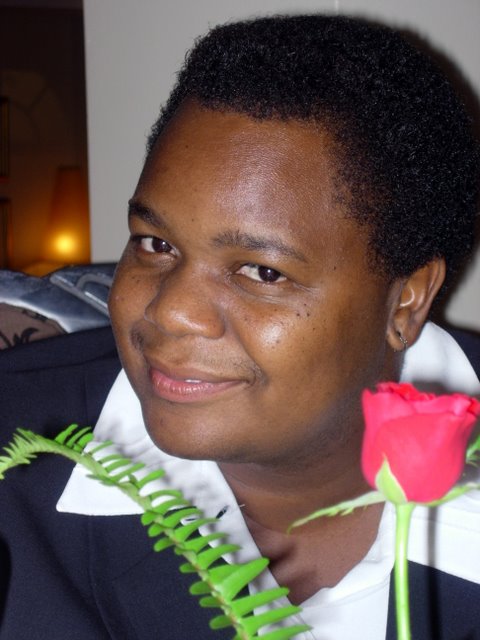 en I was walking back to my hotel, I noticed Achimwene Tebula bounding out of the Ryalls Hotel restaurant. He and my good friend Debra, the chef in Mt. Soche's restaurant (pictured with the rose), had come to their competing hotel to look for me.
I got to know Tebulo when he helped me in my quest to get on the roof of the Mt. Soche Hotel so that I could look for the Southern Cross. He ended up taking me out on a ledge outside the 5th-floor restaurant. In the course of things, Debra came out to find out what the heck we were doing there.
By the time she was able to go back inside, she had had to listen to my long-winded story about my time in Vietnam and how the Southern Cross became my friend.
She became so intrigued that she stayed outside with us for about 20 minutes.
Two nights earlier, I had invited Achimwene Tebulo, his wife and their son Raymond to dinner. Tebulo wanted to make sure how much they all appreciated the experience.
Debra was working a split shift and had come along during her break to find me. When I returned to Blantyre las week, I had visited Mt. Soche to apologize to all of my friends there for not staying at their hotel this time. Debra wasn't around -- hence, her journey to say "hello" yesterday.
While we sat -- not eating dinner -- I realized that I had invited my friend Bernard to the hotel to get a status report on his quest to help school students and orphans learn how to plant trees and raise rabbits (see my earlier blog). Some of the employees found him at the front desk, so they sent him over. Bottom line -- I found myself sitting with four wonderful friends -- friends I'm sure I will see again. The cool thing is that Tebulo and Debra became intrigued with Bernard's big little dream and vowed to help him.
It's always wonderful when one can introduce frien
 ds to other friends.
 Sunday, February 18, 2007
The Crux of the Mystery -- Solved!
 First of all, I don't need to tell you that I'm not a great artist. In fact, I'd make a better jockey or belly dancer or something.
But this is my diagram and you'll have to make do.
A bit of a lecture in astronomy here:
If you drew a line through the axis of the earth and continued it forever above the North Pole, the line would just about exactly touch the star Polaris. We also know it as the North Star because it's directly north of the Earth.
If you were to watch it all night long, it wouldn't move. All the other starts, however, would be moving in a circle around it going in a clockwise direction. The cool thing about the North Star is that it doesn't move. That makes it a pretty convenient way to always know where north is. Just find the North Star (by the way, the two stars on the far side of the Big Dipper --on the opposite side of the handle -- will always point to the North Star) and you'll be looking north. Also, if you measured how high the North Star is in the sky -- compared to the horizon and straight up -- you'd know your latitude. If the horizon is zero degrees and straight up is 90 degrees, the position of the North Star along way is your latitude. If you're on the equator, the North Star would stay on the horizon. If you were shivvering on the North Pole, it would be above you. That's how mariners can tell where they are in the Northern Hemisphere.
Problem is that the Southern Hemisphere doesn't have a "South Star" and that really sucks. The next best thing they have down here is the constellation Crux or, as many people call it, The Southern Cross. It's a kite-shaped constellation that isn't in the spot where the South Star would be if it existed, but it point in that direction -- toward where the South Star should be. Remember, the Southern Cross -- like all of the other stars in the southern sky, rotate around that spot in the sky where the South Star isn't.
So to find where the South star isn't, you measure the distance between the two stars in the kite-shaped Southern Cross that are farthest apart. Then you follow the tail of the kite four and one half times it's length and you'll be at this blank spot where the South Star should be.
In the diagram -- I know, it's really bad -- you'll see the Southern Cross off to the left just as it rises above the horizon (in February). It changes as the earth travels around the Sun and messes up the night sky. Anyway, at this time of year, the Southern Cross would be on the horizon just after sunset and would point to the right. Six hours later, however, the cross will have rotated with the night sky and be above the Celestial South Pole (that's more of an official name) and be pointing down. Six hours later, just before sunrise, it would be off to the right and pointing to the left. Just imagine it rotating clockwise across the sky. The whole trip across the sky takes 12 hours. The next 12 hours, it's still rotating in the same direction, but you can't see it because it's daytime and the sky blocks it.
When I was walking my dog at night in the dark in Vietnam in 1968 and 1969, I discovered that I could tell time by keeping track of the Southern Cross. Wherever it was when I started my six-hour shift, it would be exactly 90 degrees to the right (or clockwise) when the six hour shift was over.
I came to love the Southern Cross and, for about 38 years, I've longed to see it again. When I was in Nigeria last year, the skies were never clear enough. When I was in Nicaragua, it was the same situation. And when I was in Hawaii, it was the wrong time of year. Oh, I forgot to mention that because the Southern Cross is not exacly on the Celelstial South Pole, it's sometimes possible to see it from the lower latitudes of the Northern Hemisphere. That's how I saw it in Vietnam. But if you're in the continental U.S., you ain't never gonna see the Southern Cross.
My wonderful friend Debbie Winger (not the actress -- but more talented) was the winner. She'll win a cheap trinket of some kind from Malawi. Two other people got it, but not as quickly as Debbie.
Thanks for all the good guesses.
What some people eat in Malawi
Somebody on the blog recipient list asked for photos of the food people eat in Malawi. Here's a quickie look at three favorites.
Malawi is fa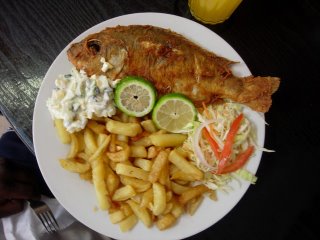 mous for its Chambo. This fish is native to Lake Malawi. Today I learned that nobody ever returns from the lake without bringing fresh Chambo back home. We carted about 50 p
 ounds of it, I think.
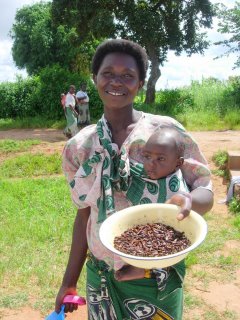
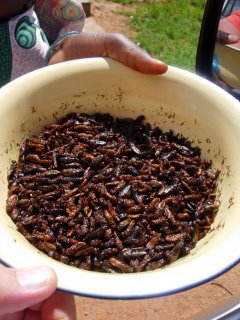
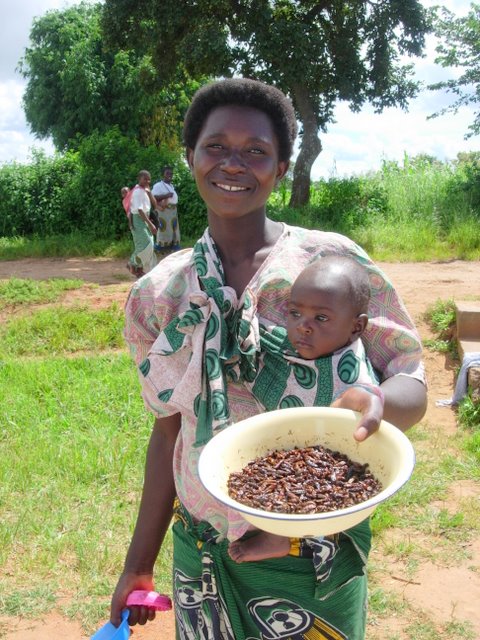
The woman you see is selling a delicacy here. They call it Mgumbi (I'm not sure if I'm spelling it right, but that's how it sounds). When evening comes they capture the flying termites by either using a light to lure them from their mountainous termite mounds or they cover the mounds with grass (or was it leaves) and then somehow capture the termites when they try to fly to the tasty stuff. Then they fry it up and sell it along the highway. It's apparently rich in fat and protein. I'll take their word for it.

An finally is the exotic stuff that I prefer to eat here.
This wonderful dish is called a BBQ Pizza. It's supposed to have steak it but, as Maria the waitress told me, "The steak is finished. We only have spicy chicken."
So you'll have to use your imagination.
Anyway, I ate it and I'm glad.
Malawi is fa
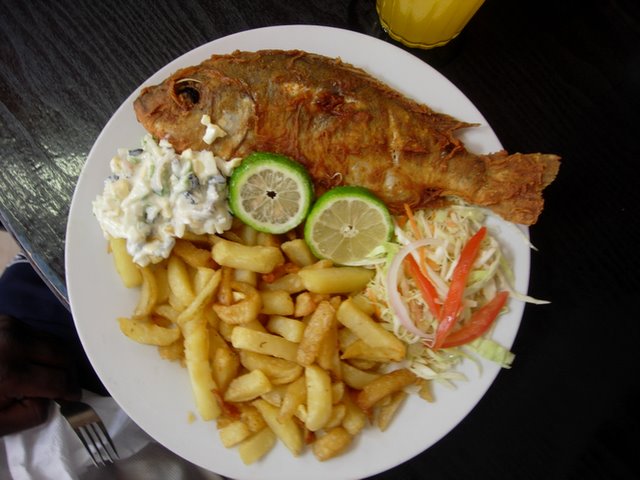 mous for its Chambo. This fish is native to Lake Malawi. Today I learned that nobody ever returns from the lake without bringing fresh Chambo back home. We carted about 50 p
 ounds of it, I think.
The woman you see is selling a delicacy here. They call it Mgumbi (I'm not sure if I'm spelling it right, but that's how it sounds). When evening comes they capture the flying termites by either using a light to lure them from their mountainous termite mounds or they cover the mounds with grass (or was it leaves) and then somehow capture the termites when they try to fly to the tasty stuff. Then they fry it up and sell it along the highway. It's apparently rich in fat and protein. I'll take their word for it.


An finally is the exotic stuff that I prefer to eat here.
This wonderful dish is called a BBQ Pizza. It's supposed to have steak it but, as Maria the waitress told me, "The steak is finished. We only have spicy chicken."
So you'll have to use your imagination.
Anyway, I ate it and I'm glad.
Monday, February 12, 2007
Bernard's Big Little Dream
Bernard’s Big Little Dream
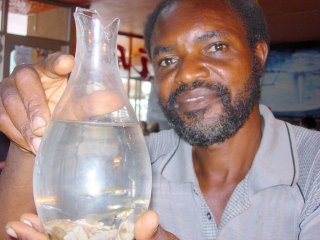
It was nice to have a day off and to finally get to walk through the city of Blantyre. I found the Alibaba Takeaway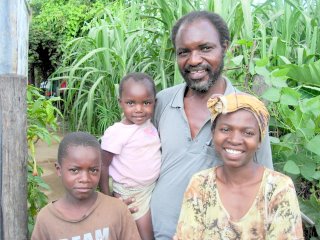 restaurant located “along Haile Selassie Road” as the menu identifies the location. The “BBQ Pizza” was as good as any BBQ pizza I’ve ever had. The BBQ meant that it had bits of steak on it.
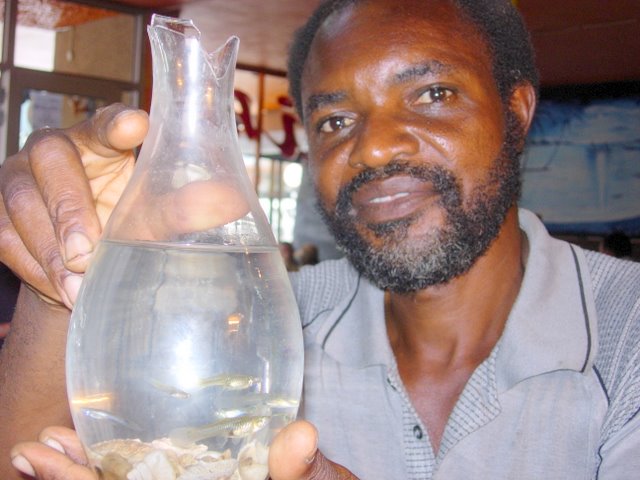
I sat in the corner table where the order counter and display case meets the wall. Bernard Madeya came in with his carafe of fish came in. He set it on the counter and spoke to one of the employees. While he waited for the employee to get the bigger boss, I complimented him on his fish and asked him about them.
“They’re a lot like goldfish, but they’re not gold and they don’t get as big. I’m seeing if the restaurant would want to have some fish here for people to look at and enjoy.”
He explained that he could build a very nice aquarium and he could come in a couple of times a week to service the fish.
It took a while, but he finally agreed to sit with me while I ate my BBQ pizza with a fork. He refused my offer to buy him lunch or at least something to drink.
We talked. Here’s what I learned:
Bernard was born in Mawali but moved to Zimbabwe when his parents divorced. His father ran a small trade school of some kind. Bernard finished high school in Zimbabwe and then went into the military there. When he got out, he accepted a scholarship to attend a university in India where he earned a degree in zoology. He returned to a now-peaceful Zimbabwe (during the time he was in the military, he was providing security to defend against guerrillas who were involved in the fight for independence).
Bernard worked for the nation’s parks department and later taught science.
In 2004, his father died and left Bernard the property where the school had been. Bernard rented out the main building to a church and another part to a mechanic. He moved into the little living area behind the building with his wife and three children.
Bernard’s dream is to create gardens and nurseries at schools and orphanages where the children can learn how plants grow. They can also raise food.
But his dream is bigger, however. He also wants to install fish ponds and cages where the children can raise rabbits and chickens and other animals. He said he was inspired when he visited his son’s school and discovered that the children had to sit on the floor during lectures. He realized that outsiders needed to help. Carpenters could volunteer to make benches and desks, he said, but since he’s not a carpenter, he wants to make gardens, ponds and nurseries.
He asked if I wanted to see his gardens at this home. I think he was surprised when I said I would certainly like that.
We called a taxi.
I only had a few minutes there, but it was enough to see his seedlings, his banana trees, his rabbits and chickens and the hole he had dug for water.
Bernard also showed me a brochure with pictures of the greenhouse he wants to buy one day to nurture the plants he’ll one day put in the schools’ gardens.
He was in the city to visit the local garden club. I told him I’d share his contact information in case anyone had ideas for him or knew of some organization that might want to sponsor one of the gardens in conjunction with the garden club.
For what it’s worth:
Bernard Madeya
P.O. Box 989
Blantyre, Malawi
He said anyone could reach him through the Blantyre City Garden Club, P.O. Box 51410, Limbe, Malawi. Their e-mail address is BCGC@africa-online.net.
He’s quite a nice man.
It was nice to have a day off and to finally get to walk through the city of Blantyre. I found the Alibaba Takeaway
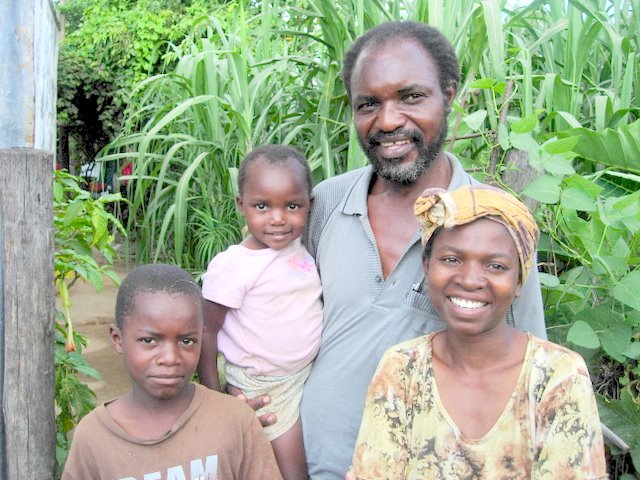 restaurant located “along Haile Selassie Road” as the menu identifies the location. The “BBQ Pizza” was as good as any BBQ pizza I’ve ever had. The BBQ meant that it had bits of steak on it.
I sat in the corner table where the order counter and display case meets the wall. Bernard Madeya came in with his carafe of fish came in. He set it on the counter and spoke to one of the employees. While he waited for the employee to get the bigger boss, I complimented him on his fish and asked him about them.
“They’re a lot like goldfish, but they’re not gold and they don’t get as big. I’m seeing if the restaurant would want to have some fish here for people to look at and enjoy.”
He explained
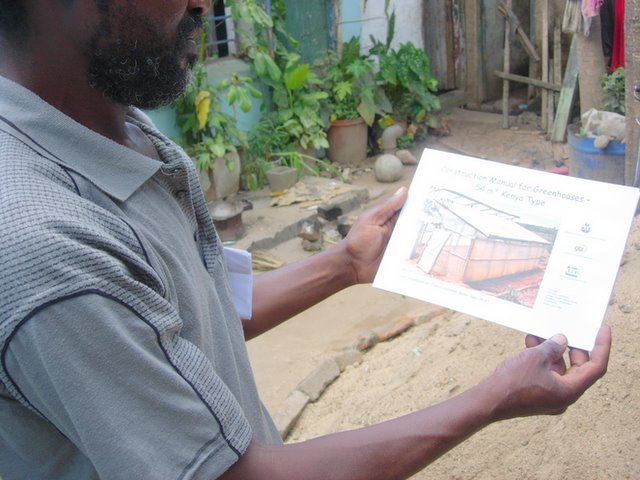 that he could build a very nice aquarium and he could come in a couple of times a week to service the fish.
It took a while, but he finally agreed to sit with me while I ate my BBQ pizza with a fork. He refused my offer to buy him lunch or at least something to drink.
We talked. Here’s what I learned:
Bernard was born in Mawali but moved to Zimbabwe when his parents divorced. His father ran a small trade school of some kind. Bernard finished high school in Zimbabwe and then went into the military there. When he got out, he accepted a scholarship to attend a university in India where he earned a degree in zoology. He returned to a now-peaceful Zimbabwe (during the time he was in the military, he was providing security to defend against guerrillas who were involved in the fight for independence).
Bernard worked for the nation’s parks department and later taught science.
In 2004, his father died and left Bernard the property where the school had been. Bernard rented out the main building to a church and another part to a mechanic. He moved into the little living area behind the building with his wife and three children.
Bernard’s dream is to create gardens and nurseries at schools and orphanages where the children can learn how plants grow. They can also raise food.
But his dream is bigger, however. He also wants to install fish ponds and cages where the children can raise rabbits and chickens and other animals. He said he was inspired when he visited his son’s school and discovered that the children had to sit on the floor during lectures. He realized that outsiders needed to help. Carpenters could volunteer to make benches and desks, he said, but since he’s not a carpenter, he wants to make gardens, ponds and nurseries.
He asked if I wanted to see his gardens at this home. I think he was surprised when I said I would certainly like that.
We called a taxi.
I only had a few minutes there, but it was enough to see his seedlings, his banana trees, his rabbits and chickens and the hole he had dug for water.
Bernard also showed me a brochure with pictures of the greenhouse he wants to buy one day to nurture the plants he’ll one day put in the schools’ gardens.
He was in the city to visit the local garden club. I told him I’d share his contact information in case anyone had ideas for him or knew of some organization that might want to sponsor one of the gardens in conjunction with the garden club.
For what it’s worth:
Bernard Madeya
P.O. Box 989
Blantyre, Malawi
He said anyone could reach him through the Blantyre City Garden Club, P.O. Box 51410, Limbe, Malawi. Their e-mail address is BCGC@africa-online.net.
He’s quite a nice man.
Saturday, February 10, 2007
Hints to Don Ray's current mystery
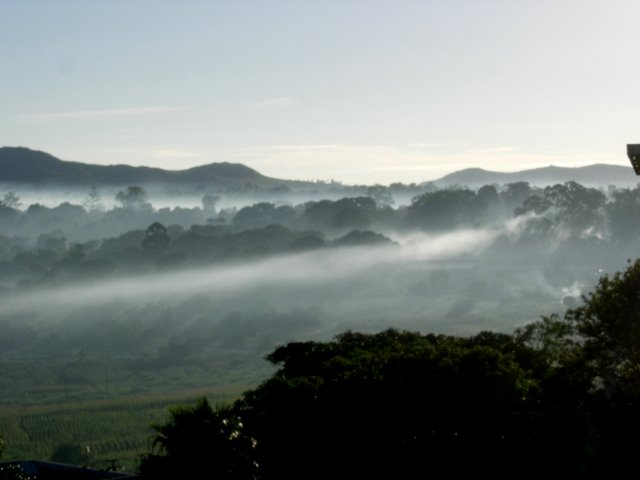
 In case the original posting didn't make the trip (I'ts so difficult and time -consuming to even e-mail somone -- much less post words and photos to the blog. But today is Saturday and I have a little bit of time.
I'm trying to re-post some photos that didn't make the trip before. Two of the photos are from outside my hotel balcony on the first morning I arose here in Blantyre, Malawi.
By the way, Blantyre is named after the Scottish city that was the birthplace of Dr. David Livingstone. He plays a big part in the history of this region (is it Livingston? forgive me if I'm wrong. I'd go to the Internet, but I'd probably screw up the posting.). Anyway, it's beautiful here. I'm going out later today and I may be able to tell you more about the city. I've ridden in a cab, but not really been able to walk around.
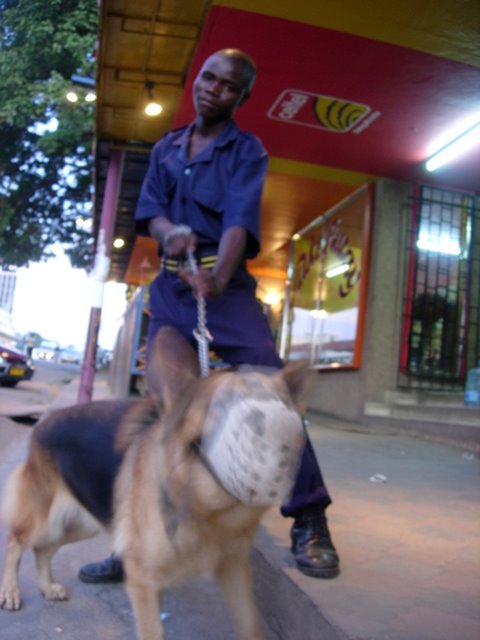 I'm including a photograph of my friend, Beston. He works at the hotel. He's put a lot of energy into helping me be more comfortable. I call him by a local nickname in the local language. I'd try to spell the name of the language, but then I'd be showing more ignorance. Anyway, I call him (spelled phonetically) Achi Mwaynay Tabo. The Achi Mwaynay part means "my brother." The Tabo is really "Table" but it sounds like Tabo. Everyone calls him Tabo, but nobody can tell me why.
Anyway, he was instrumental in helping me encounter my long lost friend (not really a person) that is the subject of the current mystery. I'll repeat the clues here:
I was able to see, for the first time in 38 years, a friend (not a person) who I saw regularly in Vietnam when I was working. It would be absolutely impossible to see this "friend" from the United States -- expect for maybe in one part of Hawaii only under the most special circumstances. I could have seen my friend from Nigeria, but not as well as in Malawi. But it didn't work out in Nigeria -- the conditions weren't right. And in Nicaragua, there was also the possibility of seeing my friend but, again, things weren't right.
I knew that Malawi was my best bet and, indeed, I was able to see my friend -- the exact same friend I had seen daily (sort of) in Vietnam. It was quite a thrill. By the way, Achi Mwaynay Tabo facilitated the encounter.
By the way, I didn't mention it before, but there's a great chance that Dr. David Livingstone was also very happy to have this exact same friend.
Some of my friends guessed that my "friend" might be a guard dog or sentry dog of some sort -- because in Vietnam I was a dog handler. One friend even suggested that maybe I was able to walk a dog around some site that needed securing here in Malawi.
Well, that's not the right answer, but it sounded like fun. I had seen some people walking big dogs -- dogs that were wearing muzzles. I asked around and learned -- to my astonishment -- that they use guard dogs at department stores and other retalil establishments. So on Thursday, after work, I asked my hosts to take me somewhere where I might smeet one of these dogs and his/her handler.
The name of the dog in the picture is "German." I know -- not too creative. But he was big and mean and -- to most people -- pretty scary. In fact, the woman I work with here, Pilirani, was not willing to get close to the dog to help me chat with the handler. But I learned enough to know that if someone tries to steal something, the handler removes the muzzle and turns the dog loose.
He told me that he's had to do that four times and each time the dog was able to recover the stolen goods -- or at least bring the fleeing thief to a bloody halt.
Indeed, the crux of the story is, when you're down south in Africa, you don't want to mess with a cross dog.
But that's not the answer to my mystery. Maybe it's a hint, however.
Can you guess the identity of my friend?By the way, I suspect that the photo of Table didn't make it. I'll try to add it later.
Malawi is Alive


OK, I confess that this is a quick posting so that I can see if I can finally get things posted here. If I put too much work into it, it doesn't work. If this ends up on the blog, I can probably go back and make some text that makes it interesting. But you have to admit that the photos are sort of cool, huh?


Subscribe to:
Comments (Atom)

