Sunday, March 26, 2006

"Falling over themselves to get all of the misery right."

A special prize for the first reader to tell me from whom I stole the title of this episode.

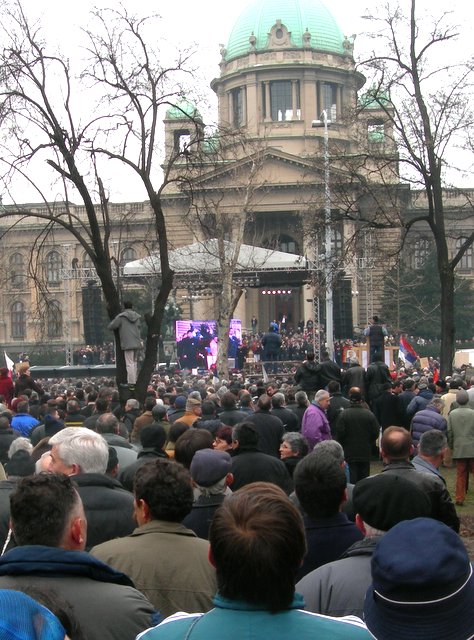
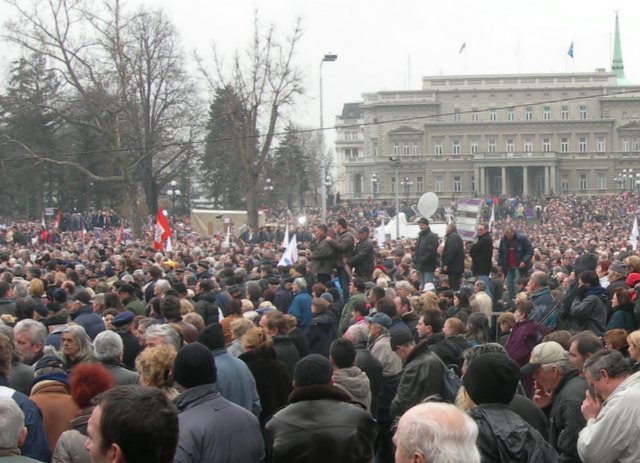
It was an amazing adventure the day they buried Slobodan Milosevic. In the late morning, people started arriving in waves to view his casket as it made a stop in front of the same Parliament Building people gathered around on October 5, 2000, and demanded he step down.

It was clear this was well organized. By 11:00 a.m. there were estimates of 50,000 -- some say 100,000 people crowded in the park across the street.

I was in the middle of the crowd taking pictures and video when I decided to call one of the producers from the TV station I'm working with and ask a simple questiong.


He told me that he was also there with a camera crew and that I should try to work my way through the crowd to where he was.

"The crowd is very angry," he said, "so whatever you do, don't speak English. Go to somewhere where there are policemen and stay there. Call me when you get there!"

By now, it was turning into one of those crowds where you actually feel the physical squeeze around you. It was nearly impossible to move. More people were trying to get to the center while I was trying to get out.

I discovered that the only way I could move against the flow was to follow behind two little old women who also had to get out.

People didn't go out of their way to help them, but they listened when the women barked at them to let them pass.

I slipped in behind them before people could close the openings they had made.

I eventually made it to an area where there were a lot of television news crews and their vans. There were two policemen standing nearby, so I stood just outside the barrier.

As I stood there, people in the crowd began throwing things at the reporters and technicians.
It turns out they were throwing snowballs, but who knew what was coming next.

Then part of the crowd started yelling in English. They only yelled two words: "F*** You! F*** You! F*** You!

I tried to call my producer friend, but the voice on my mobile phone told me, in Serbian, that I was out of credit.

Back into the crowd. It was even more difficult now. It took about 15 minutes but I pried myself through the crowd while I concentrated on not saying "Excuse me" aloud. Eventually I made it to a clearing and was able to go to a small store on a side street to buy more phone credits. By that time, the riot police arrived and I could safely return and get some more pictures and video. Eventually, the speeches ended, the casket moved on and everyone went home peacefully. Posted by Picasa

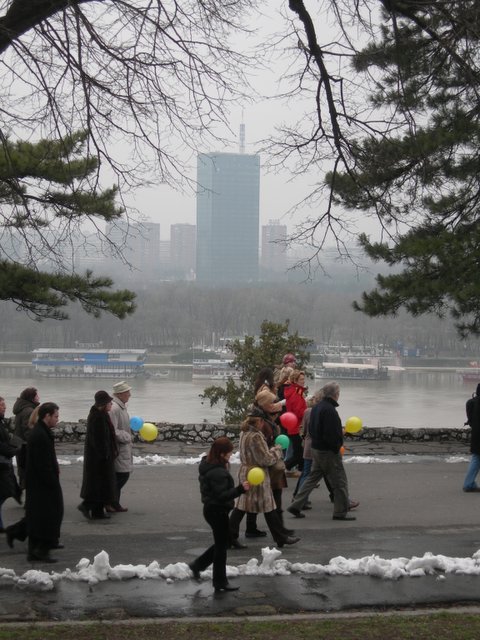
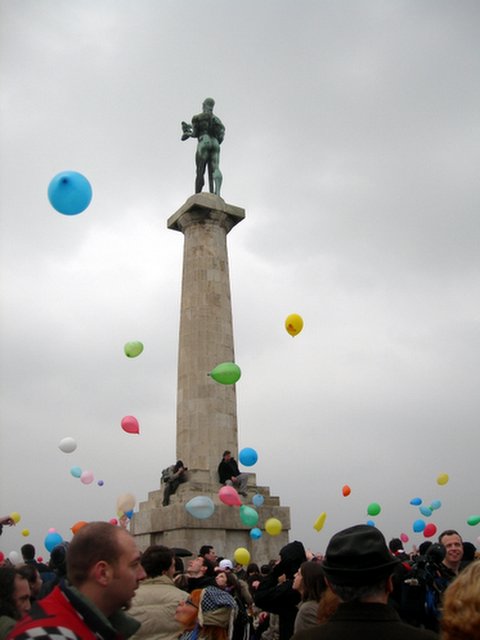
Balloons celebrate Milosevic's final exit

This is actually my way of inserting more pictures into the story that I already posted below.


Apparently there's some finite number of pictures I can put up on any one blog using the wonderful Picasa (no sarcasm intended) photo program. I use it because it easily reduces the file size of the photos. So you can enjoy the pictures here. And read more about them below.

Plus, you get a view of the people walking along the Sava River with the former headquarters of the Communist Party in the background.

This tall building is one of the many that were targets of NATO air strikes in 1999. The explosions on this building caused some minor shock damage to some of the old buildings at the old fairgrounds, Staro Sajmiste.


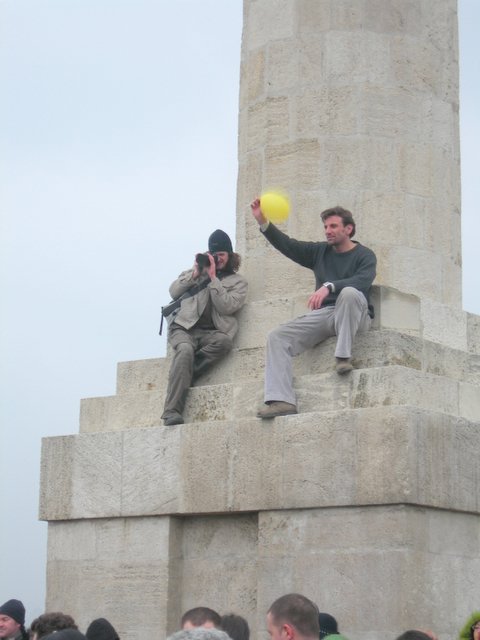
I didn't see how this guy got up on the base of the statue, but I'm certain he made it on all of the news programs.


By the time this was taken, Milosevic's body had already left Belgrade and his casket was being covered with dirt at his final resting place. Posted by Picasa

Ding Dong, Milosevic is dead.

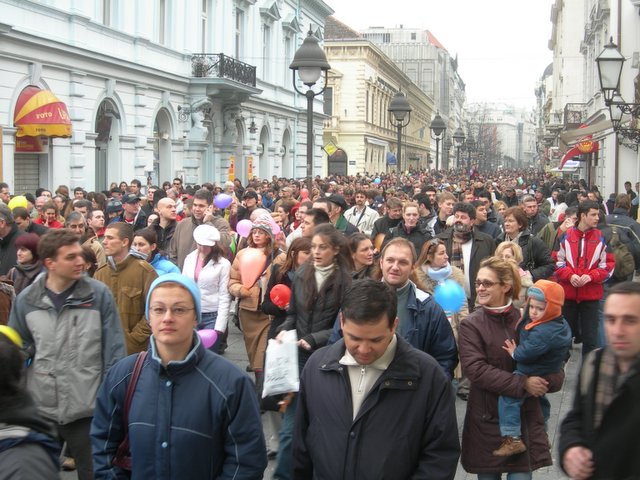
On the same day as Slobodan Milosevic's funeral, thousands of people -- mostly a younger crowd -- assembled in Republic Square with balloons and occasional whistles to celebrate what they hope will be the former president's final exit.

"Spring has come three days early," one of them said.
"We thought we were rid of him on October 5th, 2000," another said. "Then we thought he was gone when he was arrested. Or when he went on trial. Or even when he died, but he still came back. Maybe when they bury him, he'll be gone forever."

There were no leaders or speakers or plans for the rally -- just smiles, cheers, balloons and an upbeat atmosphere filled with smiles and celebrating.


After about an hour, the non-mourners began moving
through the pedestrian-only streets of the old part of Belgrade, past the shops, bookstores and restaurants that normally see a good crowd on a Saturday afternoon.

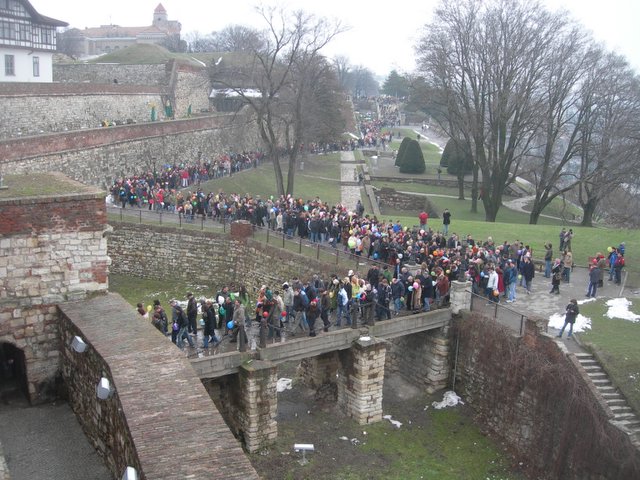
At the other end of the popular walkway, the crowd of several thousand walked through the park and into the grounds of the historic fortress of Kalemegdon where the Sava and Danube rivers meet.

Every so often, like "the wave" at a sporting event, someone would raise a balloon and cheer loudly and the cheer would grow and move down the column .

The cheerful non-mourners crossed ancient footbridges and passed through tunnels and passageways until they reached the top at the base of the famous statue that stands as a symbolic sentry for a city that never seems to rest long from centuries of wars and conflicts.

There was a party atmosphere there at the top as the afternoon clouds overflowed and sent a gentle drizzle down upon the crowd. It wasn't enough for most people to notice -- much less be concerned with.

There was no script of what to do next, so people started sending their balloon into the air. When they'd come down, they'd thump them into the air again like a beach ball at Dodger stadium. Then, the popping began and people walked peacefully home. Posted by Picasa

Friday, March 17, 2006

"The Hague turns Milosevic into a myth."

Several of my friends asked about were wondering why the media weren't describing the feelings of the people of Serbia as the funeral of Slobodan Milosevic nears. I can't answer the "why" question, but I've begun asking people I encounter about their feelings.

My straw poll was nowhere close to being accurate. One woman at the television station where I'm working was walking around in a state of numbness. She explained that seeing all of the coverage of the former president's return reminded her of the worst of times living under his rule.

"Everyone has a particular moment in their memory that haunts them," she told me. Many people were very casual in their disinterest, but I really don't believe them. I'm beginning to believe that much of the population suffers from group post-traumatic stress disorder.


They lived through years of sanctions, they watched their loved ones go off to some unknown war and they lived through the bombs and missiles that turned large buildings into rubble. For many years they had believed in Milosevic. OK, he wasn't Tito, but he seemed to be taking the country in the right direction.

The people living outside of Belgrade were the fortunate ones in terms of getting information. Milosevic couldn't control the radio and TV signals throughout the rest of Yugoslavia, so the rural folks and small villagers were the first to realize something was wrong. Eventually they marched into Belgrade and convinced the big city people to join them in throwing the bum out.

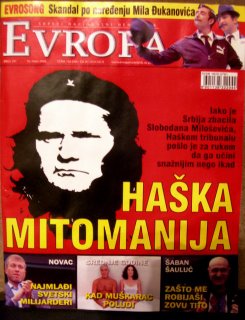
The magazine cover above sums up how many people feel. They wanted a conviction -- a quick conviction, but the chief prosecutor at the Hague tribunal apparently wasn't interested in anything short of convicting Milosevic on every count. An early conviction on even one of the lessor counts, the article says, would have satisfied most of the people.

But because he died without being convicted of anything, he began his journey to a place in group memory alongside Che Guevara. Many people seem to feel cheated. A lot of folks were counting on revenge.

Instead, they see the man being treated like a national hero.

I'm hoping to watch his casket as it moves past the parliament building tomorrow and then I'm going to a rally near my hotel where hundreds are expected to converge and remind each other how much they despised Milosevic. I'll get some comments from the people I encounter. Posted by Picasa
To Slobodan Milosevic

Thank you for all the deceptions and plunder, for every drop of blood which thousands shed on your account, for fear and uncertainty, for destroyed lives and generations, for dreams we did not translate into reality, for horrors and wars which you waged in our name, without even asking us about it, for all the burden which you placed on our shoulders.

We remember tanks in the streets of Belgrade and blood on its pavements. We remember Vukovar. We remember Dubrovnik. We remember Knin and Krajina. We remember Sarajevo. We remember Srebrenica. We remember the bombing. We remember Kosovo. We shall remember it and dream about it.

We remember the dead, the wounded, the unfortunate, the refugees.
We remember our ruined lives.

Citizens of Serbia shall remember:

Nada (Hope), Srecko (Luck), Zivko (Life), Sloboda (Freedom) Vesela (Joy) and Mile (Darling) Curcic
 Posted by Picasa

Monday, March 13, 2006

Staro Sajmiste Reveals Some Secrets


It was a dark and stormy morning . . .

Well, not really. It was raining Sunday morning, but not so hard I couldn't walk from my hotel, across the bridge to do some work at the TV station.
I had some unexpected extra time, so I allowed the magnets at Staro Sajmiste to pull me to the remains of what was as international exhibition in the late 1930s but would become a concentration camp and death camp for thousands of Serbs, Jews and Gypsies.
For those just tuning in, I've been determined to go inside some of the old buildings and find out who is living inside. I was lucky to be able to get in touch with a young man named Nemanja whom my intern in California had found on the Internet. Nemanja had posted something about a break dancing tournament he had attended in one of the old buildings at Staro Sajmiste.
He was more than willing to take the trolley there and share his English/Serbian abilities. I was also able to reach two new friends of mine, Bojan and Vladistava, who work at a book publishing company that is actually using one of the old buildings.
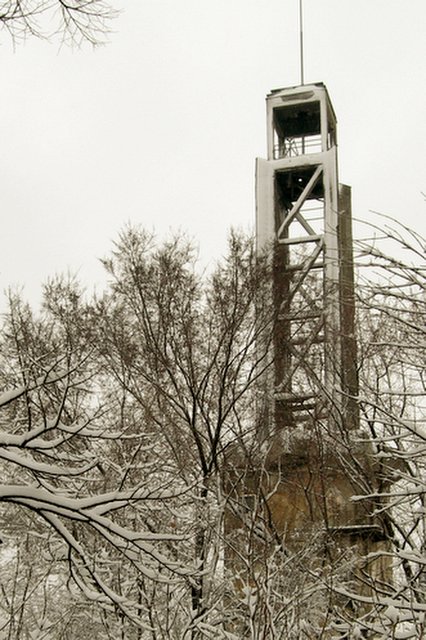
So despite the now-pouring rain, the four of us trudged through the mud to the round building with the tower on top. It was, in about 1938, the first television transmitter in Serbia. I had walked around it and taken pictures, buy my inability to speak Serbian prevented me from knocking on the door to meet the people who apprently lived inside.
We all walked into the common hallway inside the tower building. It turns out that it and other buildings there became housing for artists following World War II and the artists -- or their children -- have lived there ever since.
Nobody was home in that building, except for some cats and, based on Health Department warning signs posted on the walls, more than its fair share of rats. I wanted to go upstairs to the base of the tower, but there was a locked gate with a note attached to it with the phone number of the guy who had the key.
I called the number and handed my mobile phone to one of the others. The man agreed to come there the next day, Monday, at 6 p.m. to let us in. When that happens, I'll fill you in, I promise.
Then we went to another building and talked to a half dozen residents. It was like finally getting to go to Disneyland. Even though I didn't conduct formal interviews, I learned enough to convince me that I want to write or shoot more about this amazing place.
The picture with the white car is one I took earlier, but it's the second one we went into.
It was once the Italian Pavilion at the exhibition. In one of the rooms where the widow of one of the original artist residents sleeps, the Nazi-sympathizing Croats killed at least 100 Jews. And we learned that hundreds of people died in the tower building also.
I had to go to work, so I wrote down names and evoked promises from the people living there that I could come back later and learn more.

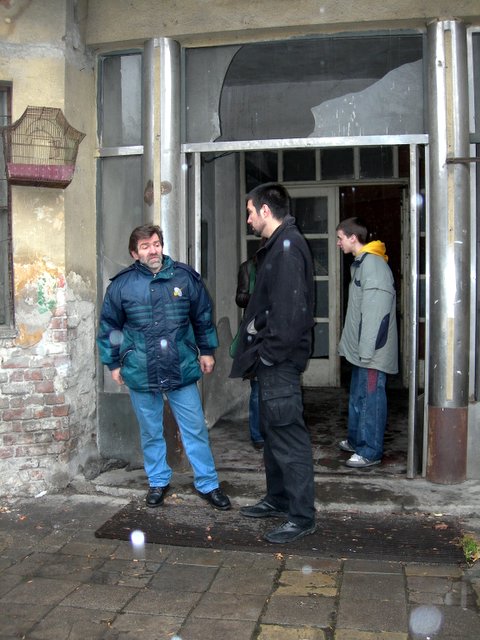
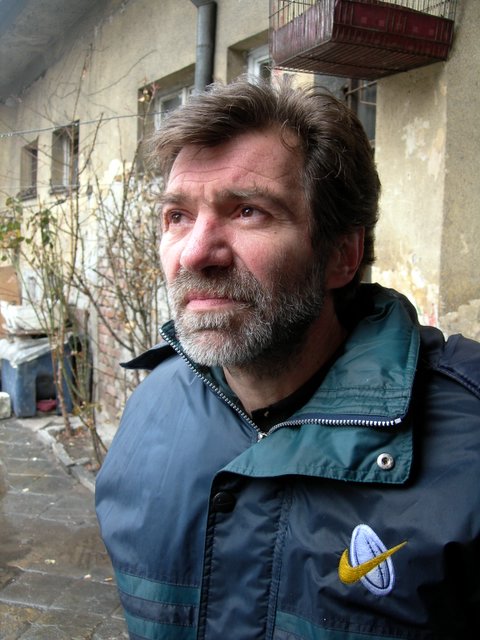
In one of the pictures you'll see Bojan talking to the bearded artist while Nemanja looks around with curiousity.


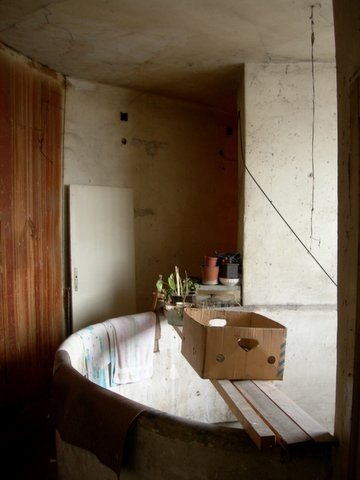
I shot two other pictures from the inside.
The overcast skies created a natural light that I'm sure would inspire any artist or photographer.


I did just a bit of Internet research when I got back to the hotel and learned that many of the Jews and others who were held captive at Staro Sajmiste had followed orders and gotten into specially designed trucks.
What they didn't know was that the trucks were driving them to where their bodies would be disposed of. The cargo area of the trucks were sealed. The exhaust from the truck's motor went straight into where the prisoners were and killed them along the way.


I read stories of how a lot of the victims froze to death when the winter snows turned everything there into ice. This morning it was snowing, so I took the taxi to work. When I saw the tower covered with snow, I paid the driver a bit more the get me close enough for a picture.

Saturday, March 11, 2006

Headlines from Belgrade

"The Hague killed Milosevic!"
That's what the first one says. It's an indicator that not everybody in Serbia is thrilled with his death. The timing couldn't be worse. Just a week ago another defendant died in jail there.
And now, everyone's wondering what impact this will have on Ratko Mladic's decision to surrender himself to the Hague Tribunal. And if he doesn't, what will the impact be if the Serbian governmet still fails to aggresively go after the man many believe is still living in Belgrade. I'm certain some of my Serbian friends will help me with the other headlines. When they do, I'll update this blog.
Posted by Picasa

What a time to be in Serbia

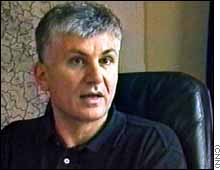
Last night I was able to meet Mila Djindjic (the easiest way to pronounce Djindjic is to replace the Dj's with a soft "g" or "j" and the "c" with a "ch" -- just say "ginger" and change it to "ginjich"), the mother of the slain Serbian prime minister, Zoran Djindjic (his picture is below).

Last week, she approached the reporter I'm consulting and invited her to sit with her at a public event. Then Mila agreed to an exclusive interview. That interview will air on Monday here in Serbia.

Today, Saturday, I set out to explore Belgrade and when I looked up and saw the Serbian government buildings, I decided to take a look at the spot where the prime minister was shot. I called the news team's director, Misha, and he talked me in the direction of the correct spot -- plus he let me know that just moments earlier the reports started coming from The Hague that Slobodan Milosevic was dead. Misha warned me to be extra careful on the streets because there was a chance there might be demonstrations or other occurances.
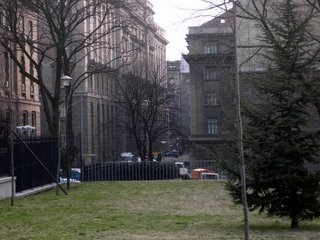
I took some pictures and video from the steps at the backdoor of the government building where Djindjic got hit by the assassin's bullets. I made a few shots in the direction of the building a block away and the third-floor window from where the bullets came. Almost immediately, the policeman at the end of the block whistled me toward him. I asked him if I could take pictures and he shook his head and waved his finger in the international sign of "Don't even think about it."

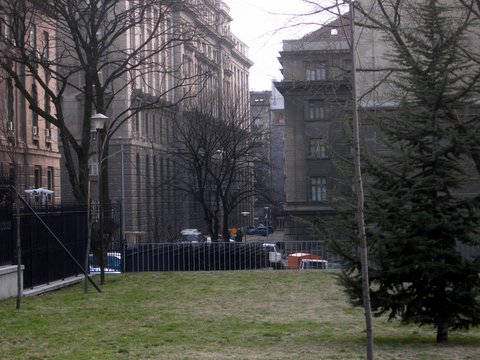
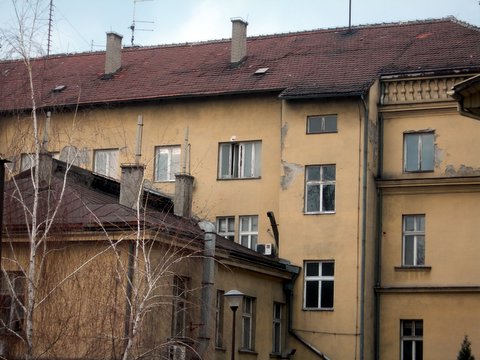
I circled around the building, walked up the street and walked into the park between the government buildings (see the view in the direction of where Djindjic was shot) and the building where the shooter was laying in wait. After I snapped off some shots and rolled some video, I went to the front of the "shooter's" building and tried to gain entrance. I wanted to look out that third-floor window (it's in the center of the picture below). The building was locked -- it has something to do with engineering, but I'm not sure exactly how. The security police in the parking lot told me to come back on Monday when the building is open.

I walked around the building again and discovered a swank restaurant adjoining the building. There was a tall, young man doing some maintenance outside, so I approached him and asked him if he speaks English.

"A little," he said. When I mentioned the window from which the assassin fired at Djindjic, he pointed it out to me. I somehow let him know that I was trying to get inside the building. At that point, the young man invited me inside where he showed me a wall that had once been an entrance to the main building, but it was plastered over now.

Then he walked me all the way through the restaurant to a table for four in the far corner. He spoke mostly Serbian, but his occassional words in English made it possible for me to understand him. He was showing me the table where the three key conspirators met every day for a year while the planned the assassination. The mastermind, Dusan Spasojevic, sat in one chair. Across from him sat the head of a secret military-style unit, Milorad Lukovic ‘Legija’ -- the man currently on trial for the assassination and, next to him, the man believed to be the trigger man.

Then the man spoke in Serbian and told more stories that I couldn't understand -- except for the words "cosa nostra," "mafia," "my father," and "my boss." If ever I wished I could speak Serbian. So I called Boske and asked him to talk to the restaurant man and have him repeat the story. Afterwards, Boske told me that the man bought the restaurant after Djindjic died and repeated what I thought I had heard about who sat where.

Then the man asked if I wanted something to drink. He served me a Coca Cola Light (Diet Coke) in a glass with ice. While I sipped, he used sign language and Serbian to make it clear to me that he had been one of the many "usual suspects" the police rounded up after the killing. He was in jail for 13 days. He told me more, but I didn't understand it. Then he showed me a newspaper with picture of Spasojevic on the front page. Spasojevic, by the way, had been killed by police shortly after the Djindjic killing. The story was in Serbian, so I couldn't tell what the story was about, except that it also had pictures of singer, Svetlana Raznatovic, known as "Ceca." She's a very popular singer and the widow of another notorious strong arm, Zeljko Raznatovic, known as Arkan. My new friend mentioned that Ceca had been arrested also.

Then it occurred to me that I had the tools with me to discover what he was saying -- eventually, at least. I whipped out my little digital video camera and a table-top tripod and sat them and my friend at the table where the conspiracy took place. He agreed to an interview profided I would not broadcast it in Serbia. I told him the video would be for my friends and family to view.

I asked him to repeat the stories he had told me. He did and he said much more.

Tomorrow, I'll go to the TV station where I have an interpreter assigned to me. Tomorrow, I'll learn what my friend had to say. Tonight, however, I'm going back to the restaurant for dinner. He assures me his girlfriend will be there and that she speaks English. It should be interesting.

In fact, I must get dressed now so I can begin part two of my adventure. Posted by Picasa

Wednesday, March 08, 2006

Walk with me to work

I awoke this morning to discover that the Blue Army had won an overnight victory over the Gray Army in the civil war of the skies. It was a great excuse to walk to the television station across the river in Novi Beograd (New Belgrade). Please join me in my camera commute.


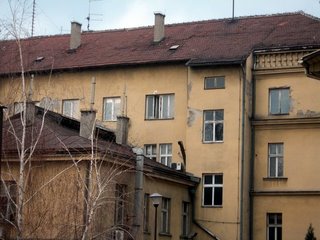
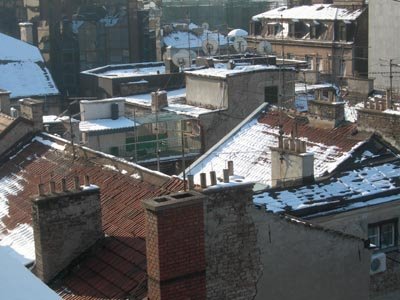
The rooftops from my balcony reminded me that I'd have to wind my way through a series of walkways and tunnels before I could reach the new bridge across the Sava.


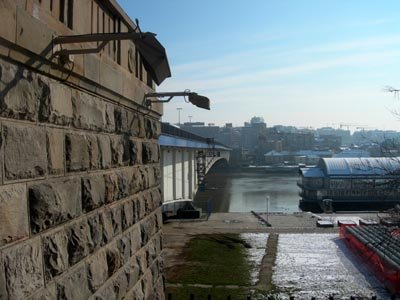
The snow and ice on the ground had morphed into harmless traces of puddles as I blended in with the foot commuters at pedestrian rush hour. But I failed to remember the seemingly senseless signs I'd seen in the mountains and in areas prone to snowfall: "Bridge Surface Freezes Before Road Surface." There were some seemingly dry pathways, but they often turned into dead ends. I walked carefully and waffled between fears of slipping off the bridge into the water or slipping in front of a bus on the roadway.


Across the bridge I was able to take the old, stone stairway that was part of the original bridge that crossed the Sava.


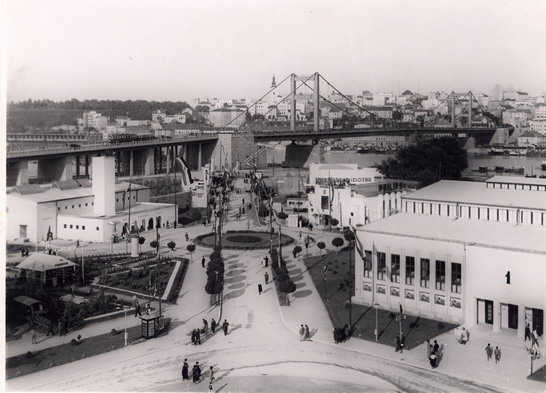
I had found an image of it in an old photo of the fairgrounds that later became the German concentration camp, Staro Sajmiste.


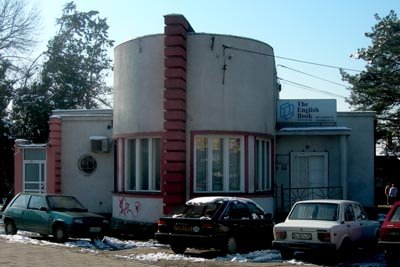
Today I had a chance to photograph some more of the buildings that I believe were part of the original fair complex, including the building now housed by The English Book, a distribution office. One of the employees there told me that it was originally occupied by the Phillips Company and it was from there they they sent out the first television signals in Yugoslavia from the transmitter that still stands across the street.


Onward into what was once swamp land but became New Belgrade in the 1940s. The images in many ways remind me of home.


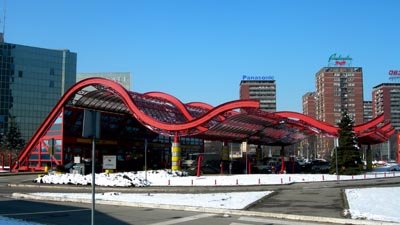
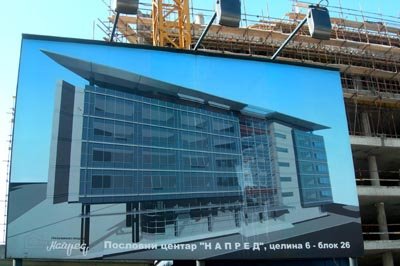
I walked past signs of progress and signs that there is life in Serbia.


I rounded the corner and walked past the typical communist apartment complexes that house a majority of the citizens.


Even though I stopped to take about 50 photographs, the journey only took a little more than an hour. I feel wonderful. Would someone remind me to get out of the car and out of the office and do some walking in California? It's so easy to forget.

Tuesday, March 07, 2006

Not much time for adventures

The assignment is a challenge and it's taking up much of my energy. However, the scenery along the way is always different and always interesting. And after I've climbed the eight flights of stairs, it's nice to have a room that isn't cramped.

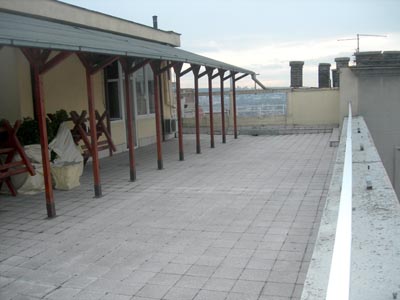
I share the balcony (or landing) with another room, but it's not occupied. It's basically all mine -- however the snow and ice have covered it. I'll have to wait until it warms up a bit to enjoy it.

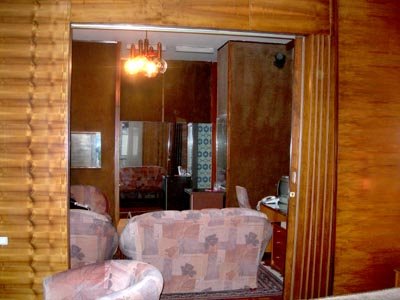
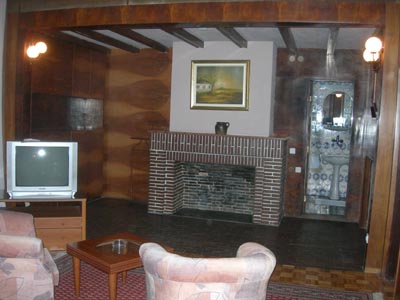
By special request, I'm including a couple of shots inside the room. The best part is that I don't trip over things -- there's enough room to move around.
Tonight I was able to visit three bookstores in search of three books I've learned about that are related in some way to the Staro Sajmiste concentration camp. I was lucky enough to find one of the books, but disappointed that there were no pictures. Of course, the book is in Serbian.

No problem. I picked up a Serbian-English/English-Serbian dictionary and in all of my spare time, I'll be able to pick out a few words here and there. As I learn more, I'll share some of the details.
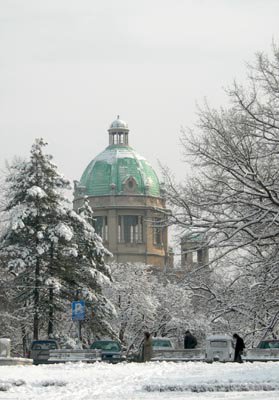
The snow has stopped falling, but because there was little wind, the snow is still clinging to the ledges, branches and streetlights. It's kind of cool. This is a picture of the parliament building across the park from where the IREX office is. I report there every morning and then take a taxi to the television station across the river in New Belgrade.

This weekend, I'm hoping to have some time to explore. If I can find anyone who speaks Serbian and English, I'd like to venture back into the neighborhood of Staro Sajmiste and see if I can talk my way into one of the old buildings -- buildings that are apparently being used as homes for either artists or Romas (Gypsies) or both.

With any luck at all, I'll be able to share the adventures with you. But for now, I must get some sleep.

Monday, March 06, 2006

Winter comes to Belgrade

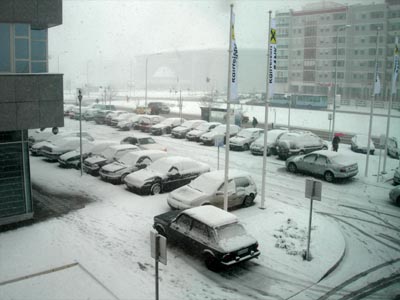
We start today's episode with today's weather. It seems that I brought with me the snow from Zurich. They say it's the first big snow storm of the season.

The first photograph is the view outside my window at the television station. When I prepared for my first visit here, I anticipated that his is what the weather would be like. So I brought lots of cold-weather stuff -- overcoats, thick jackets -- that kind of stuff.
Then, when I got here, I found that I was burning up all of the time. I quit wearing long-sleeve shirts and wore the lightest jackets if I had to wear them at all.
So when I returned, I brought lighter stuff. This morning I walked to the office in the snow wearing only my new windbreaker and it worked out well. But the snow was supposed to stop. It didn't.


Enough about the weather today. Now I want to share with you some of the views from my hotel room. I'm on the top floor of the hotel this time. I heard about a great room they called the "Qadhafi Suite." Apparently, Libya leader Muammar Qadhafi liked to stay in this room. I asked to see it before I left for home and I quickly realized the cost to upgrade would be too much for me.

But I asked anyway. The manager said, "For you, no additional cost."

So now I have a wonderful room with a balcony large enough to run laps if I wanted to. I don't need to run laps because I decided to take the stairs up to the sixth floor each time. That's exercise enough.

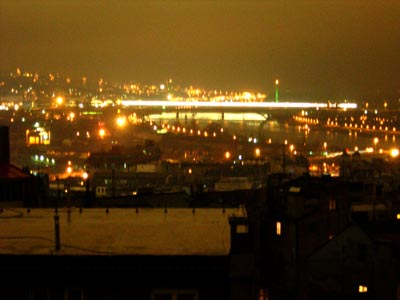
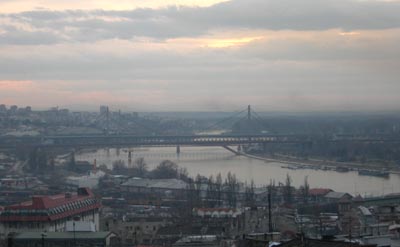
But anyway, the views are wonderful. From one side, I can look over the Sava River and see the new bridge that takes people from Old Belgrade to "Novi Beograd" -- New Belgrade. As you'll recall, the TV station is in New Belgrade. So is Staro Sajmiste, the old fairgrounds that once housed the German Concentration camp. The two photos above are the view from just before dusk and the view after dark.

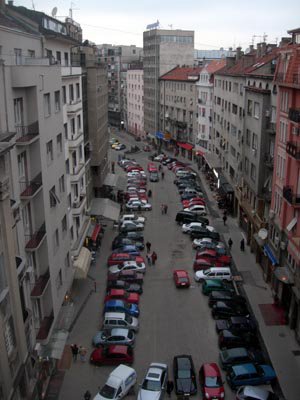
This is the view from the Balcony looking off in the other direction. Down below you can see the people walking in the people-only area of the old city. Each morning I walk down this walkway and then make a right turn at the first corner. That takes me in the direction of the IREX office where I report in every morning.

When I return this evening, I'm sure it will have more of a winter look. The final view is looking at the street that ends just before the hotel.

I'll share some interior pictures if anybody is interested.

Saturday, March 04, 2006

What I'll miss (and not miss) at home.

Dateline: Dallas/Ft. Worth Airport -- Ten minutes before boarding time. Destination: Zurich and then Belgrade. Emotions: Already missing my wife, son, inlaws and everyone else.

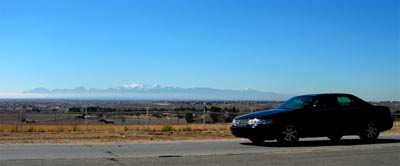
It was biting cold in the High Desert -- somehow it seemed colder than it was in Belgrade, but it must be an illusion. I changed my packing and dressing strategies. This time, short-sleeve shirts, more Levis, fewer dress pants, no bulky coats or jackets. Layers. I bought a magical windbreaker that should do the trick when the wind blows so hard that my bones curse me. It rolls up in my computer backpack so I can exercise my right to bare arms and still have some protection.

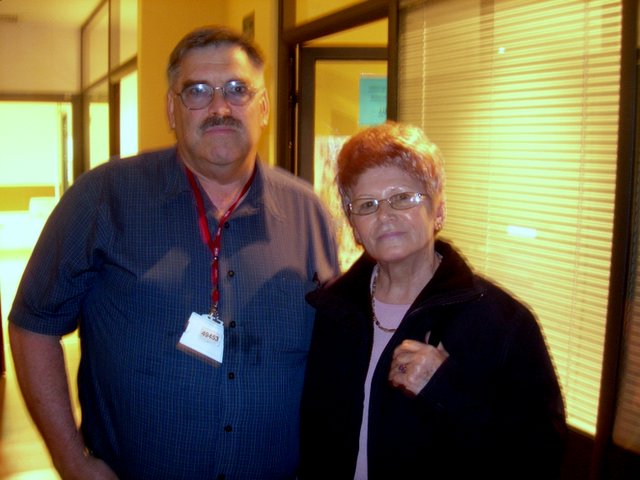
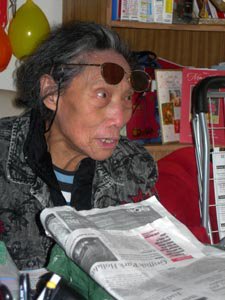
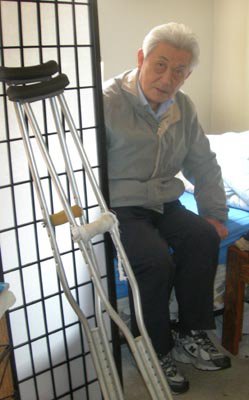
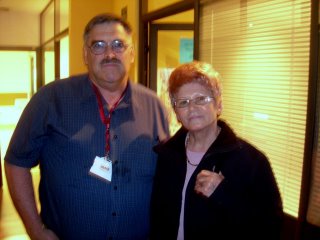
OK, here are pictures of Xiao Mei's mother and father. I didn't get any pictures of Da Hai (David) 'cuz he was off in his own world -- the world of 16-year-olds or something.

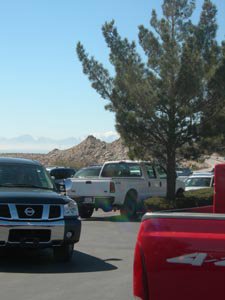
mine-has-to-be-bigger-than-yours-or-I'm-not-a-man trucks and SUVs. That's one of I'm also going to miss the desert. The part I'll miss is the wide open space with the snow-capped San Gabriel Mountains in the distance. The part I won't miss are the giant,the nicest things about Belgrade. Nobody has them. Nobody seems to want them. They're not matters of consequence. As big as I am, I can fit nicely in the front seat of a tiny taxi, thank you.

I'll arrive in Belgrade on Sunday afternoon. It's noon-15, Saturday in California right now -- 9:15 p.m. in Serbia. I'll fly through the night and somehow lose an entire day. I'm supposed to be in one of those emergency exit rows, so I may be able to actually open the laptop and work till the batteries run low. The down side is that my seatback won't go back. I'm wondering how I'll survive without being able to move my head back 1.5 inches (that was sarcasm).

They're starting to board, so I'll race to attach the pictures. Look for more later.

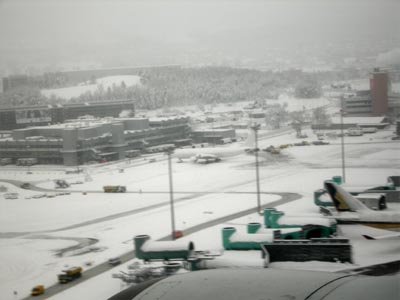
Update: Now I'm in Zurich, Switzerland awaiting my flight to Belgrade. Can you believe the snow here? Did I mention that I decided to carry only light-weight jackets so that I can work with layers? Somehow, I fear I've underestimated the coming of spring.

And for those of you who think I'm not daring, let me describe my breakfast here at the Zurich Airport:

Double Whopper with Cheese -- plain, fries and a Diet Coke. Call me Mr. International!